Application Guideline 公募情報
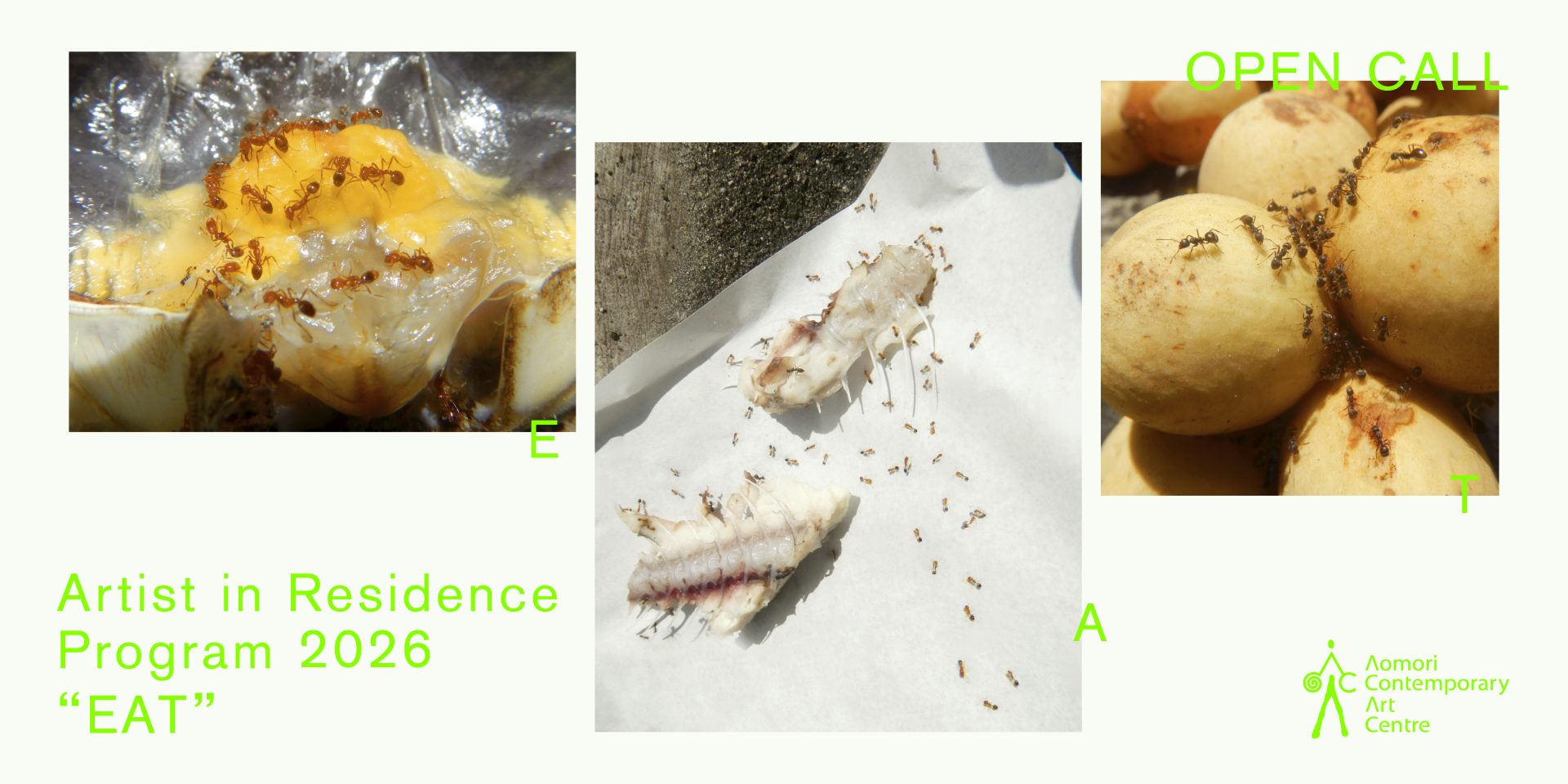
Design: UENISHI Yuri
1. Program Overview
Since its opening, Aomori Contemporary Art Centre (ACAC) has conducted an Artist in Residence (AIR) program via open call nearly every year. This year, we have classified residencies focused primarily on artistic activities (research, production of artworks, and presentation of results) under a “Creator framework.” In addition, we have added a new “Mediator framework” to encourage participation from a broad range of creatives, such as researchers and curators, whose activities are less focused on the production and presentation of artworks. The results of the “Creator framework” residencies will be presented – as artwork exhibitions, performances, workshops, or other formats – during the Results Presentation period. Presentation of results is not required for those participating under the “Mediator framework”; instead, we expect that their research activities will be premised on proactive dialogue and collaboration with the “Creator framework” participants and local residents. In both cases, residency participants will receive continuous support from ACAC staff, from research, production, and the organization of various events, all the way to the Results Presentation. Their activities will also be made available to the public through our website, program catalogs, etc.
The residence period consists of a core period lasting for 62 days (61 nights) from October 9 to December 9, 2026, during which the participants will, in principle, reside at ACAC. If desired, participants may reside at ACAC for a maximum of 92 days (91 nights) from September 15 to December 15, 2026. Please select a residence period appropriate for your desired activities.
Each year, the open-call AIR program is given a different title; the 2026 program will be conducted under the theme of “EAT.” ACAC’s location in the foothills of the Hakkoda Mountains is a landscape thriving with food, home to a diverse array of wildlife, grasses, herbs, nuts, fruits, and edible mountain plants. On the other hand, wild animals such as bears and monkeys have been appearing in human spaces more frequently in recent years. For rural areas like this, the question of how to coexist alongside non-human life is becoming an urgent one. These changes are not unrelated to the impacts of human activities, impacts which include climate change. “Eating” is not an activity reserved only for humans, but one that is practiced by all living things. In this year’s open-call AIR, we will move away from anthropocentric perspectives to reconsider our relationships with other species and the environment, taking “food” as our starting point. Here, “food” is understood in a broad sense which includes not only practices such as cooking and harvesting, but also subjects such as memory, narrative, spiritual belief, and distribution. We expect participants to approach their creative activities by moving back and forth between thought and practice as they immerse themselves in the surrounding landscape.
2. Number of Participants
1. Creator framework
Participants under this framework will engage in creative activities such as research, production, and presentation of results. Participants may, if desired, conduct a separate sub-program in addition to their main activity.
Participants selected from applicants residing outside Japan: 1 to 2
Participants selected from applicants residing in Japan: 1 to 2
2. Mediator framework
The participant under this framework will engage in research activities focused on dialogue and collaboration with the local community and with those participating under the “Creative framework.” This participant may, if desired, conduct a separate sub-program in addition to their main activity. The participant will also submit a research report.
Participant selected from applicants residing in or outside Japan: 1
* Applicants may only apply to one framework (either the “Creator framework” or the “Mediator framework.”
3. Program Schedule
Residence Period
The core period of the residency will last for 62 days (61 nights) from October 9 to December 9, 2026, during which the participants will, in principle, reside at ACAC. If desired, participants may reside at ACAC for the entire program period, or a maximum of 92 days (91 nights), from September 15 to December 15, 2026.
Core period: October 9 (Fri) – December 9 (Wed), 2026
Program period: September 15 (Tue) – December 15 (Tue), 2026
Application Period, Selection Schedule
Application period: February 25 (Wed) – April 10 (Fri), 2026 17:00 JST (UTC +9:00)
Selection schedule:
April 10 (Fri) 17:00 JST (UTC +9:00) Application deadline
Early May First screening by ACAC curatorial staff
Late May Second screening by guest judge and ACAC director/curatorial staff
Late June Selection of invitees and notification of results
4. How to Apply
Screening by application form contents and accompanying materials.
* Please submit the following application form with portfolio no later than April 10 (Fri) 2026 17:00 JST (UTC +9:00).
* If you are unable to submit the application through Google Forms, please contact us through the Inquiry form on the ACAC website.
Application Form:https://forms.gle/SZ7bVzR5P2GpaE5M7
Notes
・Before applying, please read the Program Overview and Application Guidelines 2026, Application Form Instructions 2026, and Notes on Completing the Application Form carefully.
・A confirmation message will be displayed once the application form has been successfully submitted. A copy of your completed form will be sent by email to the address you entered on the form. If you do not receive an email, please check your spam folder before contacting us.
5. Screening and Notification
Based on submitted materials, artists will be selected by 2026 guest judge IWAMA Asako and the ACAC director and curatorial staff. Applicants will be informed of the final decision by email in late June, 2026.
6. Application Requirements
a. Applicants must be individuals or groups engaged in artistic pursuits, including artists, curators, producers, art managers, art coordinators, researchers, writers, academics, designers, etc., regardless of background or genre. (Hereafter referred to as “participant(s).”)
b. Participants must understand the purpose of their visit to ACAC and be able to reside and participate during the duration of the residence period.
* Remote participation will be allowed if the organizer deems it to be necessary.
c. Participants under the “Creator framework” must present the results of their residency during the Results Presentation period. (Results may be presented in any format, including but not limited to exhibitions of artwork, performances, and workshops.) The participant under the “Mediator framework” must engage in research activities that entail dialogue and collaboration with the “Creator framework” participants, and must also submit a research report.
d. Participants must be able to communicate in English or Japanese.
e. Participants must be in good health. (Please consult with us in advance if you require special support)
f. Participants must cooperate with ACAC staff in the setup and cleanup of exhibitions or events held during the residence period.
g. Participants must be willing and able to share the communal residence facilities with the other participants during the residence period.
7. About the Results Presentation
Presentation period: November 14 (Sat) to December 6 (Sun)
Reception: November 13 (Fri)
* The specific configuration of the venue will be determined in consultation with ACAC staff.
* Installation: November 9 (Mon) to November 12 (Thu); Removal: December 7 (Mon) to December 8 (Tue)
8. Obligations of the Organizer and the Artist
The Organizer and the Participant will carry out the program upon entering into a contract which includes the following mutual obligations, which they thereby agree to adhere to throughout the duration of the program. The costs to be borne by the Organizer are calculated based on the assumption that successful applicants will come alone to Aomori; therefore, in principle, it is not possible for others to accompany the Participants during their residency. Participants can apply as a group or unit; in this case, the organizer considers 1 group or unit as 1 participant, and provides expenses (travel expenses, production expenses / activity expenses, sub-program expenses, accommodation allowance) for 1 person only.
If successful applicants wish to be accompanied by family members, assistants, etc., they must consult with ACAC before traveling to Aomori. Should ACAC approve the Participant’s request, the accompanying individuals may stay at ACAC’s facilities. In this case, the Participant will bear the travel expenses and accommodation expenses (2,040 JPY per person per night) of the accompanying individual(s).
* Please see the Program Overview and Application Guidelines 2026 for details.
9. Guest Judge for 2026 program
She lives and works in Berlin and Tokyo. Her background as both cook and artist has led her to organise a series of experimental workshops exploring the social dimensions of food. Her practice seeks to transform our perception of nourishment aesthetically and epistemologically in the relationship with nature and the person. Taking the form of films, installations and interactions, but often through the processes of cooking, her works open up a space for the public to navigate the margins between composition and constitution, affinity and social context, knowledge and history.
From 2005 to 2014, she worked at Studio Olafur Eliasson, where she conceptualized and co-ran “The Kitchen,” a canteen serving daily lunch in the studio, and co-produced TYT (Take Your Time) Vol. 5: The Kitchen (2013), later republished by Phaidon as Studio Olafur Eliasson: The Kitchen (2016). From 2019 to 2020, she was a fellow at the Jan van Eyck Academie. Her exhibitions include IJssel Biennale(Dieren, Netherlands, 2025), São Paulo Biennial (Sesc Vila Mariana, 2025), Punya 2.0 (Kunsthalle Bern, 2024), Yokohama Triennale 2020 Afterglow, Istanbul Design Biennial (2020–2021), Things Entangling (Museum of Contemporary Art Tokyo, 2020), Foodscape: We are what we eat(Arts Maebashi, 2016–2017), techne, n. (Den Frie Centre of Contemporary Art, 2014), Europe (to the power of) n (Haus der Kulturen der Welt, 2012), Scenarios about Europe: Scenario 2 (Galerie für Zeitgenössische Kunst Leipzig, 2011–2012).
10. About Aomori Contemporary Art Center
Aomori Contemporary Art Centre (ACAC) is an art center offering a flagship Artist in Residence (AIR) program through its residential art facility. Since its foundation in 2001, the program has been an active platform for a diverse range of artists in their creative pursuits and presentations. Located in the foothills of the Hakkoda Mountains, residents can enjoy a rich natural environment while still being close to the center of Aomori City. ACAC’s architectural design is the work of internationally-acclaimed architect, ANDO Tadao, and features the concept of “invisible architecture”. The center consists of a production studio (Creative Hall) and an accommodation facility (Residential Hall), encouraging interactions with others while providing a comfortable space for visitors to focus on their creative work.
ACAC’s AIR program is an initiative expected to foster a variety of expressive activities which can only be realized in this unique environment. The center aims to be an inspirational space for all involved, emphasizing interactions between domestic/international artists and local communities. Since 2009, when ACAC’s management was transferred from Aomori City to Aomori Public University, ACAC has also been conducting exchanges with students studying at the university in fields such as management, economics and regional development.
11. Contact and Inquiries
For inquiries regarding application to this program, please contact us using the Inquiry form on the ACAC website.
* Please note that we are unable to respond to inquiries by telephone.
Inquiry form: https://acac-aomori.jp/inquiry/
Translation (partial): Ethan Sames