AIR2025「CAMP」レビュー:境を越えてから、そして島になる(戴周杰)
AIR2025”CAMP” Review: Crossing boundaries and becoming islands (DAI Zhoujie)
- 日本語
- ENGLISH
境を越えてから、そして島になる
戴周杰
2025年度、国際芸術センター青森(ACAC)は施設の大規模改修に伴い、展覧会などに使用される展示棟を含めて休館に入った。そのため、今年度のAIRプログラムは、JR青森駅東口ビル内の協同組合タッケン美術展示館を成果発表の場とし、AIRの成果展としては開館以来初めて、いわば“アウェー”の会場で開催されることとなった。展覧会タイトルが示すとおり、今期の参加アーティスト5名による展示は、青森駅前に一つの巨大な「CAMP」が出現したかのようにも感じられる。
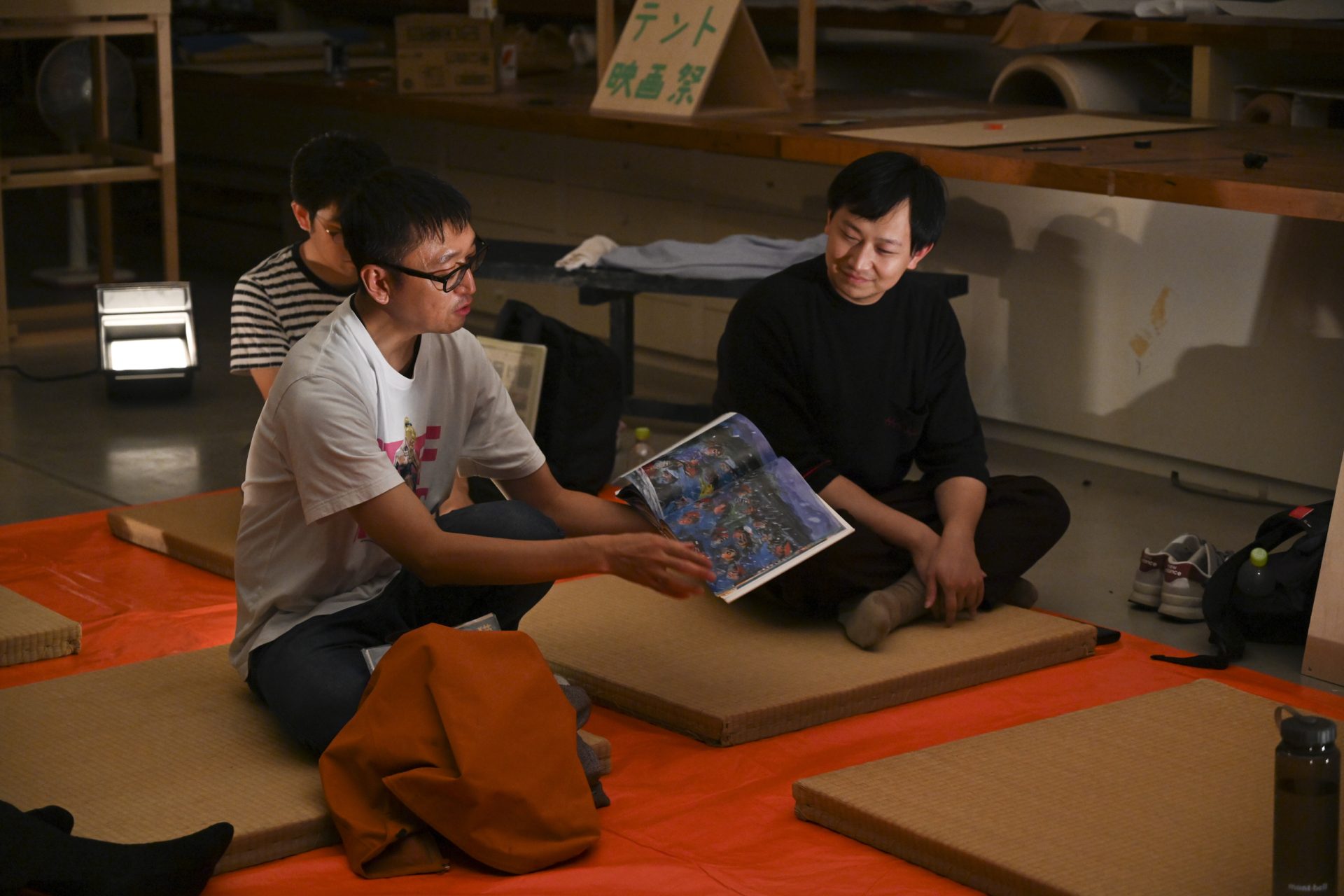
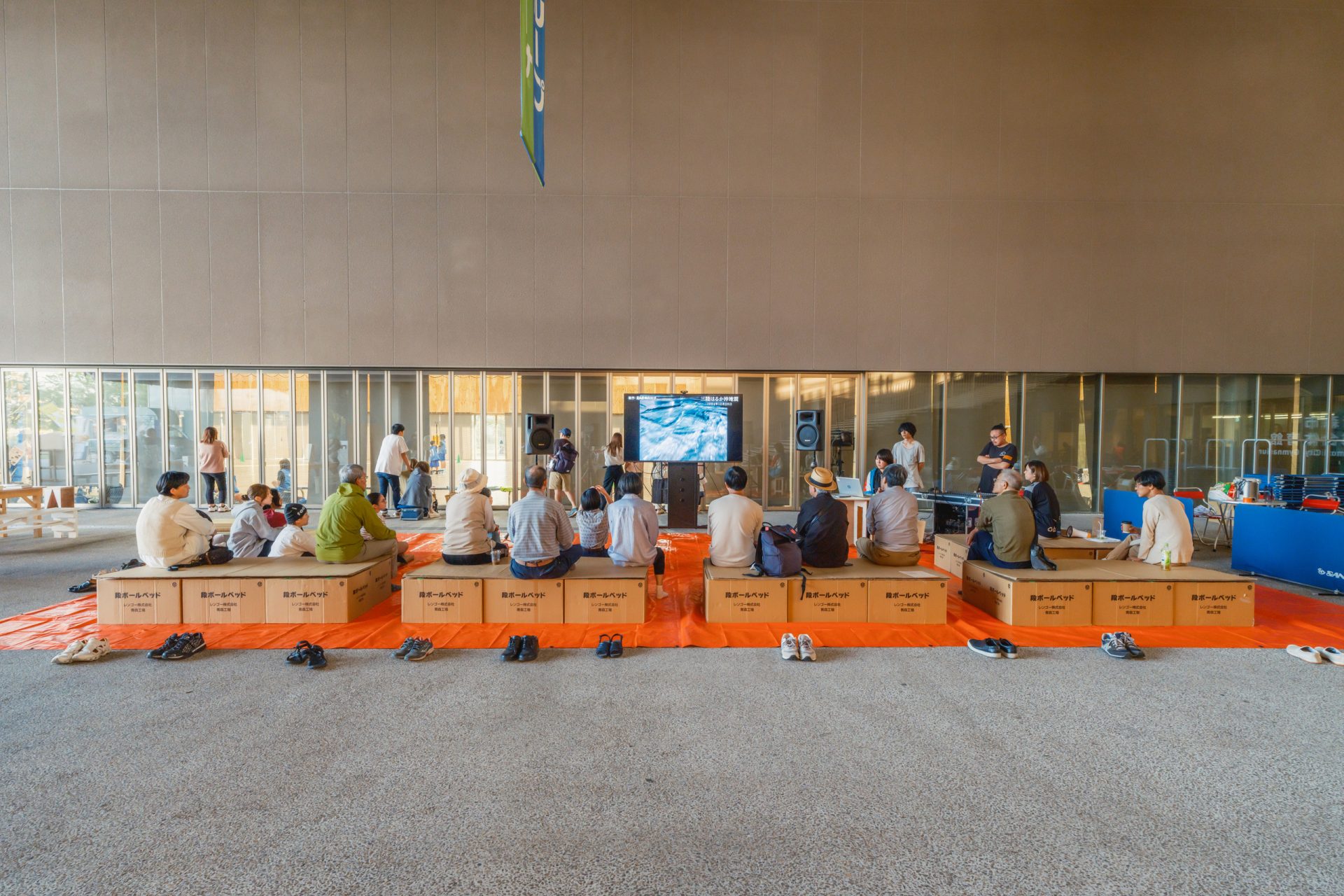
この成果展に先立ち、9月下旬にはACACにて一泊二日を過ごす「ACACベースキャンプ」と、青森市中心部に新設された防災拠点・カクヒログループスーパーアリーナ(青森市総合体育館)で行われた「テント映画祭」を組み合わせた複合プロジェクト「(災害ユートピア)」が開催され、筆者も一参加者としてこれに参加した。改修工事による休館中だからこそ可能となったACACベースキャンプでは、「もしACACで被災したら」という仮定のもと、スタッフやゲスト、青森公立大学の学生を含む参加者全員が、ACAC館内でキャンプを行い、避難訓練を体験するという趣旨が掲げられていた。
去る2024年には能登半島地震が発生し、来たる2026年には東日本大震災から15年を迎える。二つの大きな震災の体験と記憶の境に立つかのような年の瀬、12月8日には青森県東方沖を震源とする地震が発生し、筆者が居住する八戸市では最大震度6強を観測した。中国大陸出身で、これまで大きな地震を経験したことのなかった筆者にとって、至近距離で地震に直面したこの体験は、強烈な恐怖と不安を伴うものだった。そのような状況下で本稿を執筆すること自体が、ある特別な意味を帯びていたのかもしれない。
ACACの広い展示室にダンボールベッドや寝袋を並べ、参加者とともに一夜を過ごす経験は、おそらく最初で最後になるだろう。クマの出没が懸念され、単独で屋外のトイレに行くことすら制限されるという、限界に近い生活環境のなかで、年齢も国籍も職業も異なる参加者たちは、不思議な親密さを伴った一つのコミュニティを形成していった。その瞬間、レベッカ・ソルニットの著書から生まれた「災害ユートピア」という概念[1]に、身体的な実感をもって共感できたような気がした。
「ACACベースキャンプ」の参加者の一人が、今期の公募型AIRに採択されたアーティスト、前谷開である。キャンプの翌日、参加者全員でACACを出発し、街中のカクヒログループスーパーアリーナ(青森市総合体育館)まで歩いたのだが、前谷はキャンプ用品一式に加え、写真制作のための一眼レフカメラや三脚など、途方もない量の荷物を詰め込んだ巨大なリュックを背負い、まるで修行者のように最後まで歩き続けていた。
本AIRの参加アーティスト5名には、ある共通点があることに気づかされる。それは、「島」との深い関わりである。前谷は、島国・日本の主要4島のなかでも最も小さい四国島の愛媛県出身で、穏やかな瀬戸内海は、常に見慣れた原風景だという。丹治りえは福島県出身だが、大学院進学を機に沖縄県へ拠点を移し、以降も本土外の地である沖縄に暮らし、独自の「シマ」[2]社会に身を置いている。アディ・スンドロは、東南アジアの島国・インドネシア出身で、同じ島国である日本に滞在するなかで、両国の文化的・社会的差異への好奇心を糧に、身近な素材を用いた制作を行っている。アティッタヤポーン・センポーは、タイ東北部イサーン地方の出身で、中央文化圏から周縁化され、言語や民族の点でラオスに近いとされながらも、どちらにも還元されない独自の文化を育んできた、いわば「陸の孤島」とも言える地域を拠点としている。サマンサ・クラークは、イギリス北部スコットランドのオークニー諸島を拠点に、島々を取り巻く風や水といった自然要素に呼応する作品を制作している。
大陸国家において海はしばしば天然の障壁と捉えられるが、島国においては、むしろ海こそが道となる。それぞれ異なる「島」から、本州島最北端の地である青森に集ったこの5人のアーティストの出会いは、偶然というよりも、ある必然だったのかもしれない。
一方、戦後80年を迎える2025年は、遠くはパレスチナやウクライナの戦禍から、近くは台湾問題をめぐる日本と中国の緊張関係に至るまで、戦争という人的災害が常に世界の各地で進行している年でもある。分断が深まる世界は、それぞれが孤立した島のようにも見え、そのなかで故郷(国/家)を失った難民たちは、やむを得ずキャンプに身を置き、国境を越えて安全な場所を求め続けている。そうした光景を重ね合わせると、地球そのものが一つの巨大なキャンプとなりつつあるかのようにも思えてくる。このような時代背景が幾重にも折り重なるなかで、「CAMP」をタイトルに掲げた今期の公募型AIRの成果展は、さまざまな意味において特別な展覧会であったと言えるだろう。
前谷の作品は、「(災害ユートピア)」プロジェクト終了後の9月下旬、12日間をかけて津軽半島を徒歩で巡った経験をもとに制作されている。道中で目にした風景や出会った人々、さらにはその風景のなかに立つ自らの姿を写した写真群が、陸奥湾沿岸部に点在する朽ちた小屋を想起させる落枝を用いた構造体に、時間の流れに沿うかのように配置された巨大なインスタレーションである。展示の一角には、徒歩の途中でテントを張る様子を記録した映像作品もあり、そこでは指にはめられた結婚指輪の存在が印象的に映し出されていた。それは意図的な演出であるようにも思われる。前谷は、ACACの公募採択を機に会社員としての仕事を辞め、単身で青森へ向かったが、その決断の背後には妻の後押しがあったという。巨大なリュックを背負う前谷の姿は、「家」という重要なものをも同時に背負っているかのようであり、そのことが作品に秘められた温度として、確かに伝わってきた。
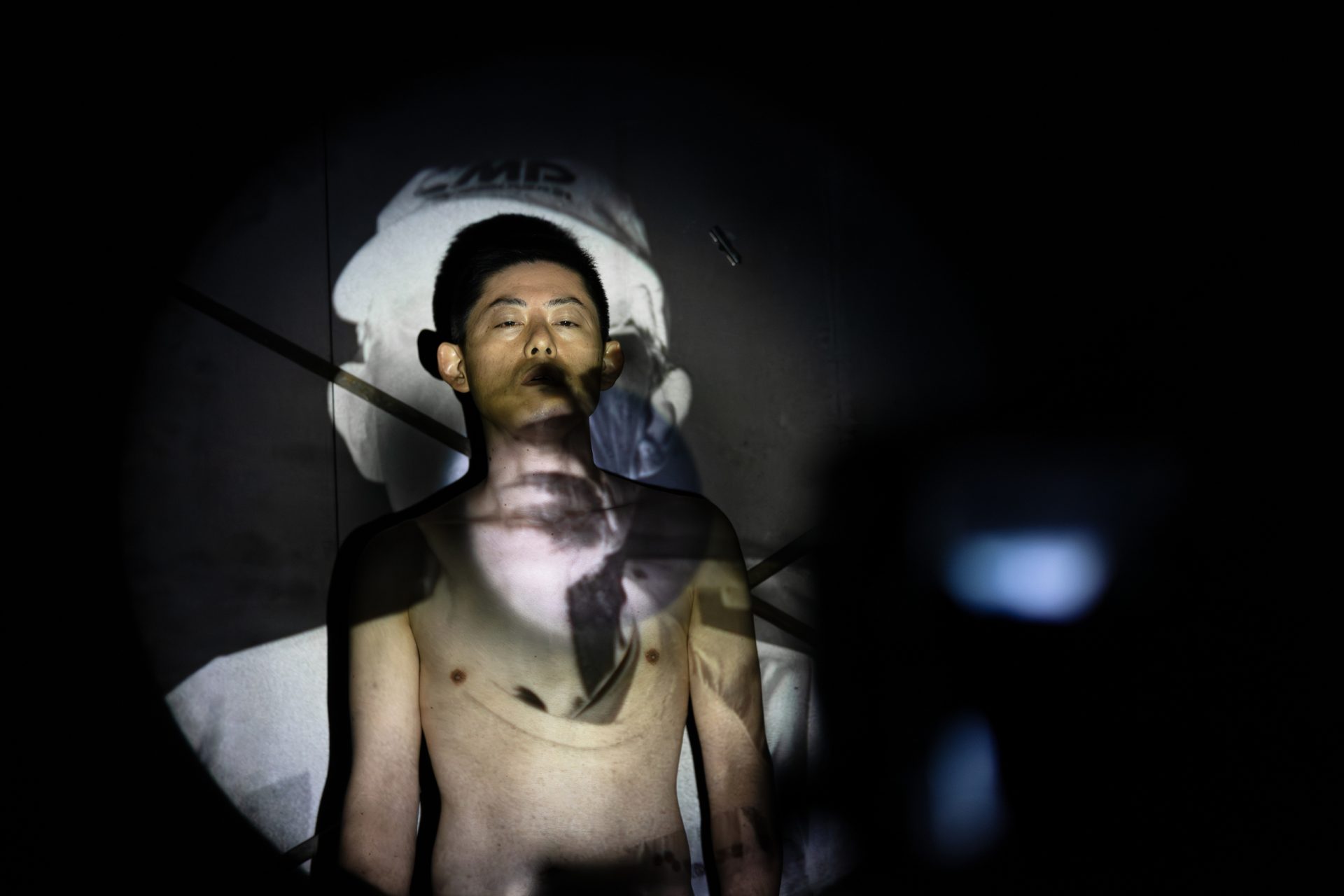
展覧会最終日には、前谷によるパフォーマンスにも立ち会うことができた。パフォーマンスのタイトル《歩く、眠る》は、「移動/越境」と「国/家」という二重の概念を内包しているようにも思われる。会場となった旧ユースタイルは、また別の意味で「CAMP」を思わせる建物であり、日が沈むにつれて、前谷は身にまとっていた衣服をすべて脱ぎ、徒歩で巡った津軽半島の写真群を自らの身体に投影していった。身体はキャンバスであり、スクリーンでもあった。静まり返り、闇に包まれていく会場のなかで、筆者の脳裏には、初めて前谷と出会った「ACACベースキャンプ」、そして地震によって停電した部屋での記憶が重なってよみがえってきた。
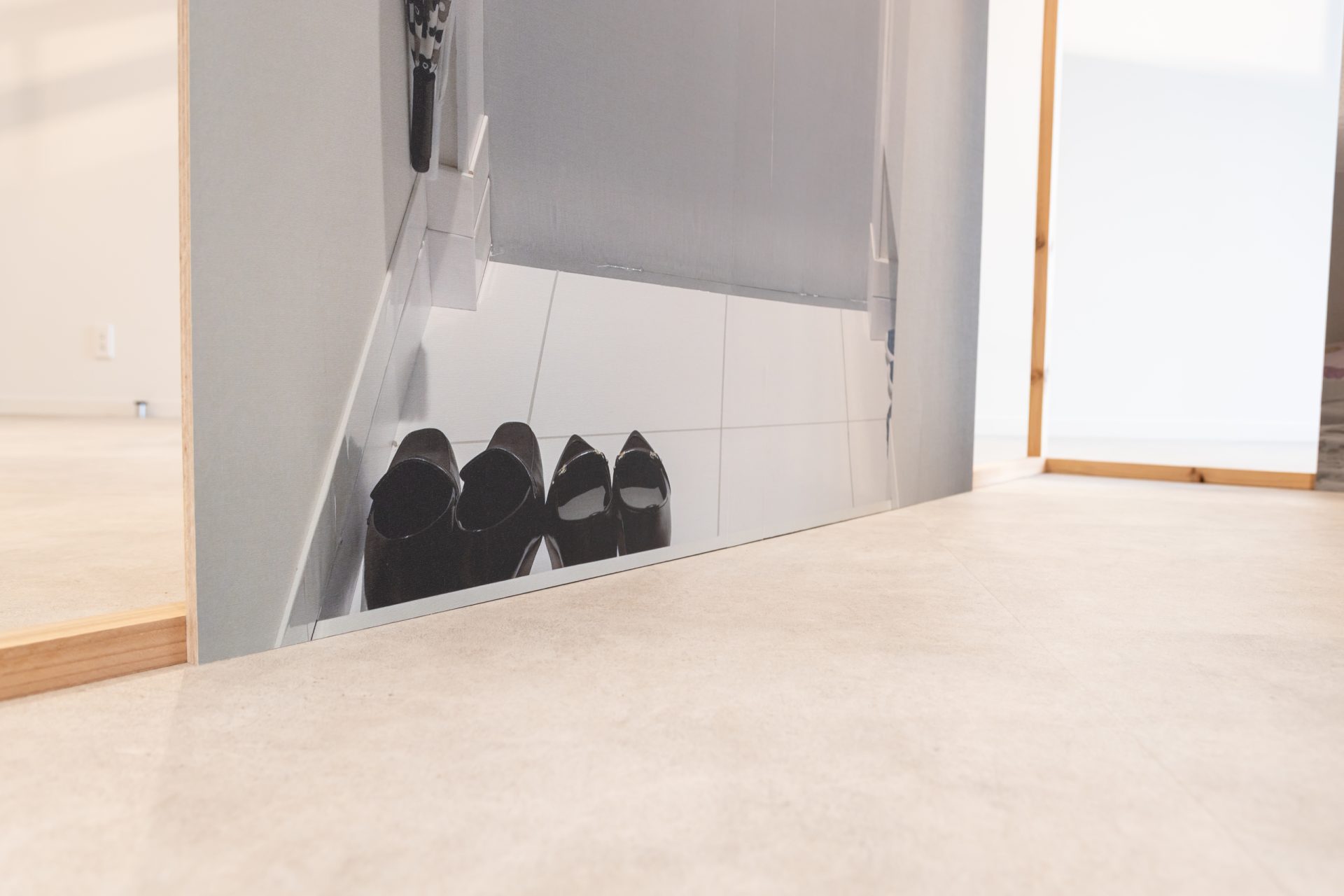
丹治は、三沢市や六ヶ所村など青森県上十三(かみとうさん)地域を中心にリサーチを行い、そこで出会った人々の記憶や、リサイクルショップで収集した日用品などを素材として制作を行った。それらは、一見するとどこにでもありそうな都市の居住空間のように展示されながらも、実在の場所や人々と切り離された形で可視化されている。丹治の拠点である沖縄県と同様、米軍基地の存在が大きな比重を占める三沢市は、基地との共存によって成立してきた街とも言われる。一方、原子燃料サイクル施設を多数抱える六ヶ所村は、国家主導の巨大開発計画である「むつ小川原開発計画」[3]の中核を担ってきた地域である。軍隊、基地、政府、国家権力──そうした複雑な力学が交錯する土地のアイデンティティを、丹治は丹念な調査によって掘り下げていく。誰かが暮らしていそうでありながら、誰の家とも特定できない生活空間として立ち現れる作品は、上十三地域と沖縄、それぞれの地で人々が問い続けてきた「他者」と「自己」の境界に、静かに迫っているように思えた。
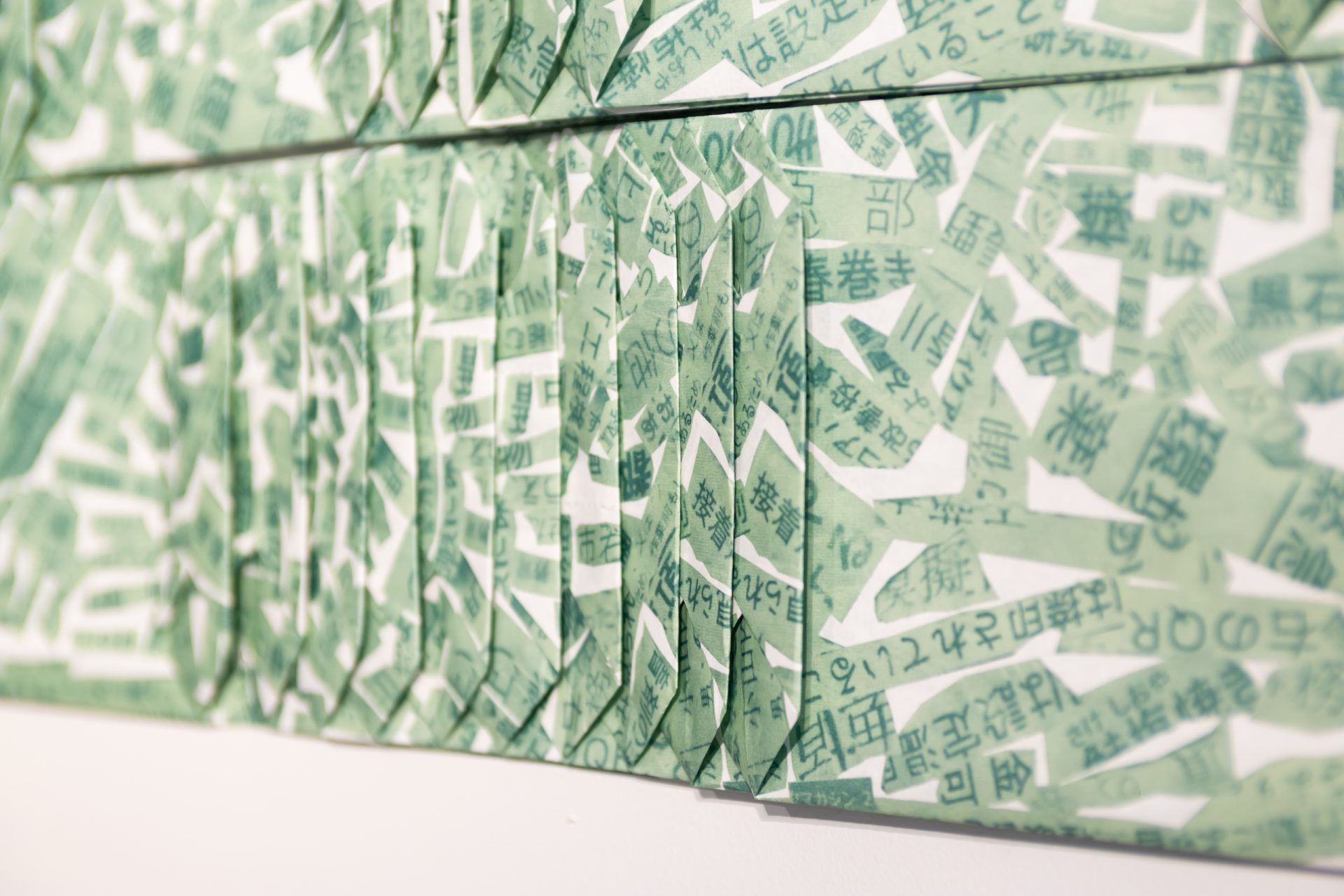
スンドロは、東南アジア最大の島国インドネシアから、東アジアの島国である日本へと移動しながら、両国におけるプライバシー意識や、個人情報と公共空間の境界を探っている。コンビニエンスストアで購入できる揚げ物の包装紙という、誰にとっても身近な存在に着目し、それを専門領域である版画へと展開する。反復的で一見シンプルな構成のなかに、大量生産と消費によって生み出される膨大な情報の氾濫、そしてそれに翻弄される現代社会における「私的」と「公的」の境界が、鮮やかに浮かび上がる。個人情報の保護を重視する日本と、それとは対照的なインドネシアの状況をスンドロは語る。監視社会へと急速に向かう現代において、プライバシーの定義が揺らぐなか、彼の作品はその検証のための一つのサンプルとなっている。また、揚げ物を歩きながら食べるという行為は、日本とインドネシア双方で共有される日常的な風景であり、加速する社会における「移動しながら生きる」生活様式として、キャンプ的な身体感覚をふと想起させる。
センポーの作品からは、故郷であるタイ東北部イサーン地方への深い愛着が感じられた。イサーン地方は、タイ中部とラオス、カンボジアに挟まれた古来の農業地域であり、全国人口の約3分の1を占めるにもかかわらず、現在も最も貧困な地域の一つとされている。バンコクを中心とする中央文化圏とは異なる歴史を歩んできたため、長年にわたり排除や差別の対象ともなってきた。この土地に積層する歴史の変遷と、その地中深くに潜むイサーン固有のアイデンティティの一端を、センポーの作品は雄弁に語っている。青森県における豊年祭「虫送り」[4]という津軽の儀式との共通性を見出したとき、両国の「東北地方」を結ぶ、思いがけない接続点が浮かび上がった。また、日本に出稼ぎに来たタイ人労働者の記憶を手がかりとする映像作品は、キャンプと移民というテーマの深い関係性を、具体的な像として提示していた。
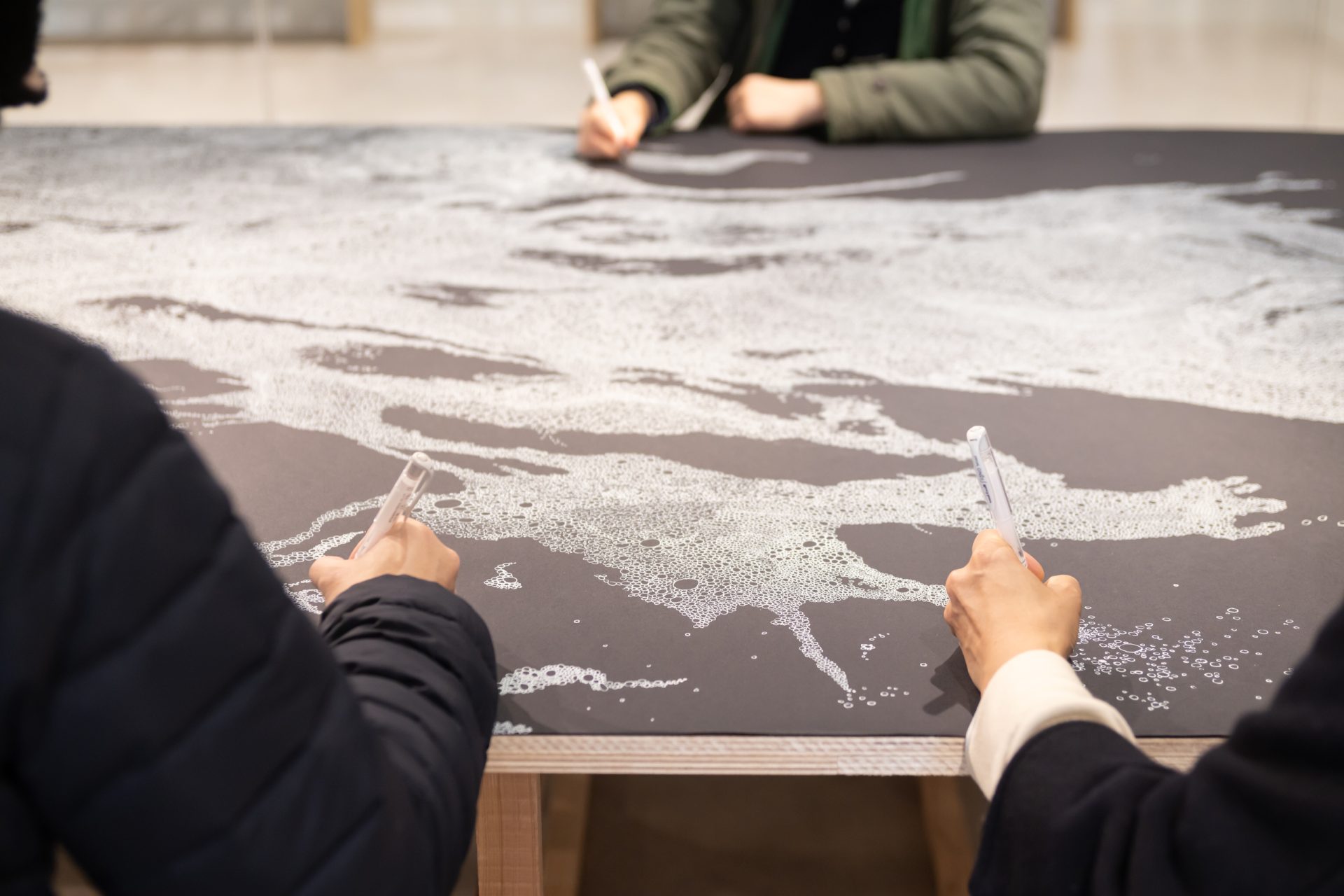
クラークの作品は、タイトル《Confluence(合流)》が示すとおり、一貫して「水」というモチーフへの関心に貫かれている。泡のようにも見える円を、巨大な絵巻物を思わせる紙面に繰り返し描くことで、やがてそれらは川や海の水面として立ち現れる。参加型の作品として、来場者一人ひとりが円を描く行為に関わることで、さまざまな思いが重なり合い、無数の円=泡が合流していく。クラークの作品に触れるたび、中国春秋時代の思想家・老子による「上善若水」[5]という言葉が思い起こされる。水は自己主張をせず、低きに流れ、どのような器にもその形を合わせる。一方で、円を描き続けるという瞑想的な行為は、小さな動きがやがて大きな力となる可能性を内包しており、「石の上にも三年」ということわざをも連想させる。
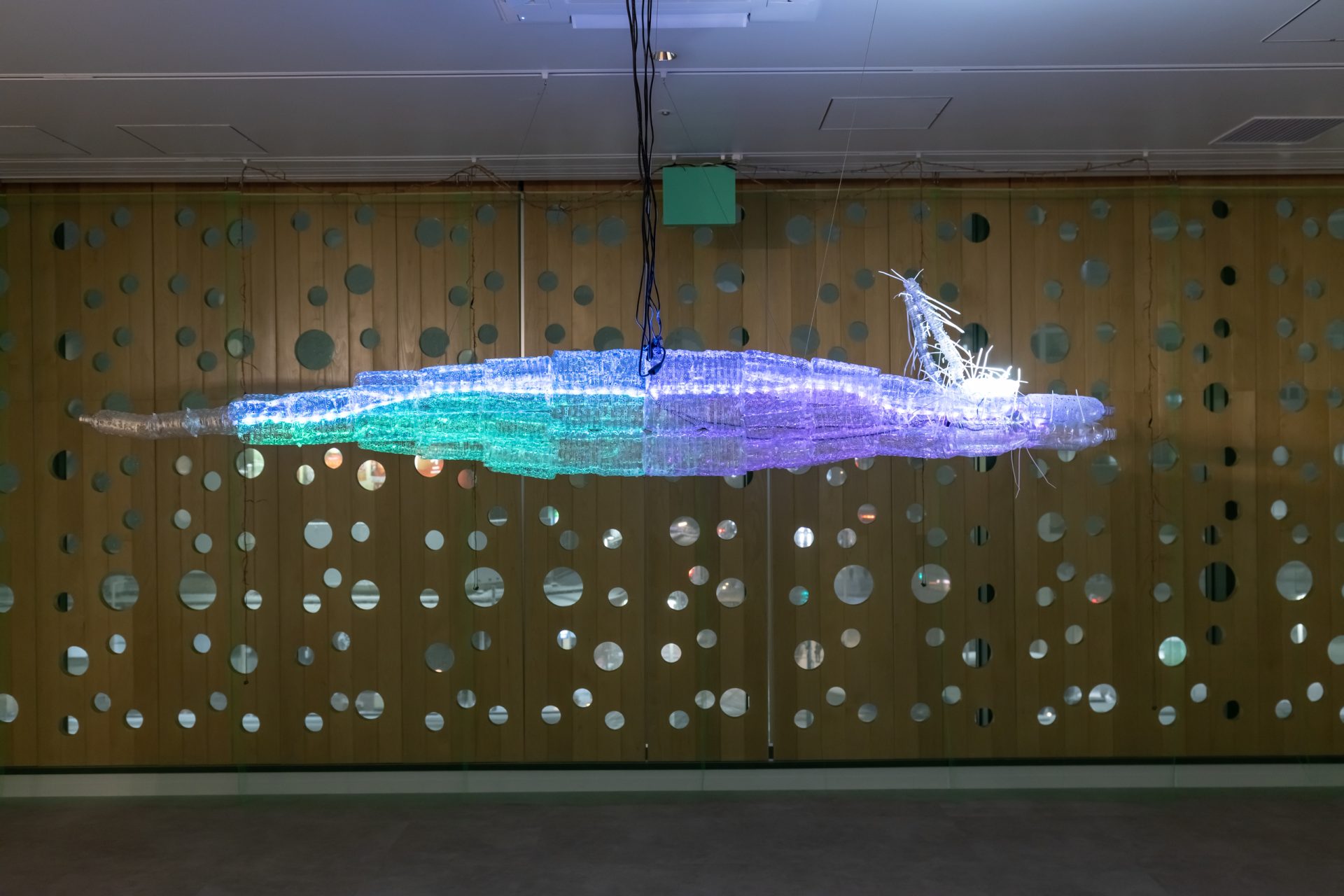
成果展が閉幕した翌日には、ACACにてクラークによるパフォーマンス「水を返す」が行われた。会場に展示されていた、世界各地から集められた水をすべてACACの池に注ぎ、新たな循環を生み出すパフォーマンスである。さまざまな思いを宿した水が池に注がれ、波紋が広がり、やがて遠くへと流れていく様子を、スタッフや参加者とともに見守りながら、人と水、そして島と海との共生関係について、改めて考えさせられた。
パフォーマンスが終わる頃、池の背後にそびえる展示棟では、改修工事の進行に伴い、足場が徐々に撤去されつつあった。新生ACACの姿が、ついにその輪郭を現し始めていた。
ー
[1]アメリカ出身の著作家レベッカ・ソルニットが、著書『災害ユートピア』(2009年)において提唱した概念である。災害発生後、被災者同士の利他的な行動を通じて、一時的な共同体が形成される現象を指す。
[2]沖縄の地域社会における「シマ」とは、単に「島」を意味する語ではなく、地域、集落、故郷、共同体といった重層的な意味を持つ概念である。沖縄方言(しまくとぅば)では、「出身者」や「村落」を指す言葉として用いられている。
[3]1960年代末以降、青森県上北郡六ヶ所村を中心とする地域において、石油化学コンビナートや製鉄所を中核とした大規模臨海工業地帯の整備を目的として構想された開発計画である。「世界最大の開発」とも称されたが、コンビナート建設は実現せず、後に原子力関連施設が進出することとなった。
[4]津軽地方では、田植えが終わると「サナブリ」と呼ばれる農休みの時期に、「虫送り」と呼ばれる行事が行われる。これは、農作物に付く害虫の駆除を主な目的とし、集落にとっての災厄を送り出すことで、農作と村内の安全を祈願する伝統行事である。
[5]老子の著した『道徳経』に由来する言葉であり、「上善如水(じょうぜんみずのごとし)」とも表現される。最高の善は水のようなものであるという意味を持ち、柔軟性や謙虚さ、そして大きな度量を備えることの重要性を示している。
写真:岩根愛
-
戴 周杰DAI Zhoujiemore
八戸工業大学感性デザイン学部助教。1993年中国湖南省生まれ。2015年に北京電影学院広告監督専攻卒業後に来日。東京藝術大学大学院映像研究科に在学中、監督・編集を担当した作品が国内外の映画祭にノミネート。東京都写真美術館映像部門インターンおよび第12回恵比寿映像祭アシスタントを経て、2020年より木下惠介記念館・浜松市鴨江アートセンターに勤務。上映プログラムや映画資料展覧会の企画、映像系ワークショップを担当。仕事の傍ら社会人院生として静岡文化芸術大学大学院文化政策研究科でアートマネジメントと文化政策を学ぶ。2025年より現職。専門は映画制作、アートマネジメント、映像アーカイブ。
Crossing boundaries and becoming islands
DAI Zhoujie
Due to major renovation work, the facilities of Aomori Contemporary Art Centre (ACAC) were closed throughout 2025. This included the Exhibition Hall, where exhibitions and other events are normally held. As a result, the 2025 Artist in Residence (AIR) programme held its Results Presentation at the Aomori Citizens’ Art Gallery inside the JR Aomori Station East Exit Building. This marked the first time since ACAC’s opening that they had taken an AIR exhibition ‘on the road’, so to speak. True to the exhibition’s title, the presentations by the 5 participating artists conjured up images of a giant ‘camp’ set up in front of Aomori Station.
In late September, prior to the Results Exhibition, the multidisciplinary project (SAIGAI Utopia) was held in two parts: ACAC as a Base Camp was held over 2 days at ACAC, while Film Festival as a Tent was held at the newly opened Aomori City Gymnasium in downtown Aomori City. I was one of the participants. The former (which was only possible because ACAC had closed for its renovation work) was based on the premise: What if ACAC was struck by a disaster? The participants, which included ACAC staff, guests, and Aomori Public University students, camped for a night inside ACAC, allowing us all to experience what an evacuation drill is like.
The previous year, 2024, saw the Noto Earthquake in Ishikawa Prefecture, while the following year, 2026, would mark 15 years since the Great East Japan Earthquake and Tsunami. As if straddling the borderline between the experiences and memories of these two major disasters, an earthquake struck off the eastern coast of Aomori Prefecture on December 8, registering as high as an Upper 6 (the second-highest level) on the JMA Seismic Intensity Scale in Hachinohe City, where I live. Born on the Chinese mainland, I had never experienced such a strong earthquake before, and this close encounter brought on intense feelings of fear and uncertainty. I feel as though this context imbues the review I am writing here with special meaning.
As part of ACAC as a Base Camp, I helped line up cardboard beds and sleeping bags inside ACAC’s spacious gallery, and spent the night there with the other participants. This experience was my first (and hopefully last) opportunity to know what an emergency evacuation feels like. Living at the limits of civilisation, where even going to the outdoor toilet alone was restricted due to concerns about marauding bears, the participants overcame differences in age, nationality, and occupation to form a mysteriously close-knit community. As this reality dawned on me, I felt a tangible identification with Rebecca SOLNIT’s concept of the ‘disaster utopia’[1].
Another participant in ACAC as a Base Camp was MAETANI Kai, who was also one of the artists selected for the open-call AIR being held in conjunction with the (SAIGAI Utopia) project. The day after the campout, the participants all walked from ACAC to the Aomori City Gymnasium in the city centre. For the entire journey, Maetani, like some sort of ascetic, shouldered a gigantic backpack crammed with an absurd amount of gear, including camera equipment for his photographic work, along with all of his camping supplies.
I noticed that all 5 artists invited to this AIR had something in common: they all had a deep connection to ‘islands’. Maetani is from Ehime Prefecture on Shikoku, the smallest of the 4 main islands of the island nation of Japan. For him, the tranquil Seto Inland Sea is an indelibly familiar landscape. TANJI Rie, meanwhile, is from Fukushima Prefecture on the main island of Honshu, but moved to Okinawa when she entered graduate school. Since then, she has continued to live in this distinct ‘island’[2] society far from the Japanese mainland. Adi Sundoro is from Indonesia, the largest island nation in Southeast Asia. During his stay in Japan, he created works using everyday materials while drawing inspiration from his curiosity about the cultural and social differences between the two island nations. Atittayaporn SAENPO comes out of the Isan region of northeast Thailand. Marginalised from mainstream Thai culture, and sharing closer linguistic and ethnic ties with Laos, Isan has developed into a kind of ‘landlocked island’, with a distinct culture all its own. Samantha CLARK is based in the Orkney Islands of Scotland, in the northern United Kingdom. There, she creates art that responds to the natural elements surrounding the islands, such as wind and water.
For mainland nations, the ocean is often understood as a natural obstacle; but for island nations, the ocean is the road itself. That these 5 artists all travelled from their respective ‘islands’ to encounter each other here in Aomori, at the very northern tip of the main island of Honshu – this was perhaps more inevitability than accident.
While the artists were conducting their residencies, the human disaster of war continued to rage in every corner of the world throughout 2025 – the 80th anniversary of the end of World War II – from faraway horrors in Palestine and Ukraine, to strained relations closer to home between Japan and China over the Taiwan issue. The world is becoming more and more divided, with each side resembling its own remote island. In their midst, refugees who have lost their homes (nation/family) find themselves moving from camp to camp, country after country, in search of safe places to live. Picturing all these scenes together makes me wonder if the Earth itself is becoming one enormous camp. Given these layers upon layers of historical context, the Results Presentation of this year’s open-call AIR, titled CAMP, was in many ways a special exhibition.
Maetani’s work was based on a 12-day trek that he took around the Tsugaru Peninsula at the end of September, following the conclusion of the (SAIGAI Utopia) project. His massive installation consisted of a collection of photographs taken along the way, capturing his encounters with landscapes and people, as well as his own figure standing in the middle of these scenes. The piece was arranged on a structure made of fallen branches as if following the passage of time, and evoking the dilapidated huts scattered along the coast of Mutsu Bay. In one corner of the installation was a video recording of Maetani pitching a tent somewhere along his trek, the wedding ring on his finger strikingly highlighted. I believe that this arrangement was intentional. Upon learning of his selection to the ACAC open-call residency, Maetani quit his company job and travelled to Aomori alone, but he said that his wife encouraged him in this decision. It was as if, somewhere in that gigantic backpack of his, Maetani was also carrying his beloved ‘home’ around with him, and that subtle warmth comes through in his piece.
I was also able to witness the performance Maetani gave on the final day of the exhibition. The performance’s title, Walk, Sleep, seems to encompass the dual concepts of ‘movement/borders’ and ‘nation/family’. The former ‘U-STYLE’ building, which served as the venue, brought the idea of camping to mind in a different way. As the sun sank, Maetani took off all his clothes and projected onto his body the collection of photographs from his trek around the Tsugaru Peninsula. His body was turned into a canvas, or a screen. Memories of ACAC as a Base Camp, where I had first met Maetani, flooded into my mind, superimposing themselves onto the hushed and darkened venue. I was brought back to that moment when the lights in the room where the Base Camp participants had gathered were suddenly turned off, simulating a power outage after an imaginary earthquake.
Tanji conducted research centred around locations in the Kamitousan region of Aomori Prefecture, such as Misawa City and Rokkasho Village. Her works incorporated her memories of the people she met there, and used everyday goods that she collected from second-hand shops. These sets, which at first glance seemed to depict scenes that one might find in any residential area of any city, were visualised in a way that was detached from any actual place or person. Misawa City, where the American military base plays a major role in citizens’ daily lives, is often described as a city that depends on its coexistence with said base. It is similar in this respect to Okinawa, where Tanji lives. Rokkasho Village, meanwhile, boasts a large number of nuclear fuel recycling facilities, and has long formed the core of the ‘Mutsu-Ogawara Development Project’[3], a massive state-led initiative. Militaries; bases; governments; state power – Tanji’s meticulous research delved deep into the identities of places where such complex dynamics intersect. Her works manifested as homes that people might actually have been living in, although they could not be identified as belonging to any specific person. It seemed as though these works were quietly approaching the boundary between ‘Other’ and ‘Self’, a question long pondered by the people of both Kamitousan and Okinawa.
Adi travelled from Indonesia, the largest island nation in Southeast Asia, to the East Asian island nation of Japan. His work explored the two nations’ respective attitudes toward privacy and the boundary between personal information and public space. His work focused on a familiar, everyday object – paper used to wrap fried food sold in convenience stores – only this time applied to the specialised field of printmaking. Out of this repetitive and apparently simple construct, the overwhelming deluge of information generated by mass production and consumption was vividly propelled to the forefront, along with the blurring of the boundary between ‘private’ and ‘public’ in a modern society caught up in this deluge. Adi spoke about Japan’s emphasis on the protection of personal information and about the situation in Indonesia, which stands in stark contrast. His work stood as a testament to the changing definition of privacy in a modern world rapidly advancing toward a surveillance society. Later, we munched on fried foods as we strolled around, and act which – albeit an everyday sight in both Japan and Indonesia, and characteristic of the kind of ‘on the go’ lifestyle we find in our ever-accelerating society – suddenly brought to my mind the physical sensations of camping.
Saenpo’s work showed her deep attachment to her homeland, the Isan region of northeast Thailand. Sandwiched between central Thailand, Laos, and Cambodia, Isan has existed as a largely agricultural area since ancient times. Despite comprising roughly one-third of the national population, it remains one of the country’s poorest regions. As its historical path has differed from that of the Bangkok-centred mainstream Thai culture, Isan has long been subject to marginalisation and discrimination. Saenpo’s work eloquently spoke to the multilayered history of this land, and to its unique and deeply-rooted identity. When she discovered common ground in the form of the mushiokuri[4] harvest ritual of the Tsugaru Peninsula, an unexpected connection emerged between the ‘northeast regions’ of both countries. And her video piece, which drew on the memories of Thai migrant labourers in Japan, gave form to the profound relationship between the themes of camping and immigration.
Confluence, the title of Clark’s work, reflects her consistent fascination with the motif of ‘water’. Paper resembling an enormous picture scroll was covered with hundreds of circles; eventually, the circles took on the appearance of bubbles foaming across the surface of a river or an ocean. Confluence was a participatory artwork, and as each visitor participated in the act of drawing these circles, their myriad thoughts and feelings intertwined, and the countless circles/bubbles joined together to follow a single flow. Each time I encountered Clark’s work, I was reminded of a phrase attributed to Laozi, the famous philosopher from the Spring and Autumn period of ancient China: ‘The highest virtue is like water’[5]. Water seeks its own level without asserting itself, conforming to the vessel that contains it. On the other hand, the contemplative act of drawing circle after circle implied the potential for small actions to eventually become a great force, which also brought to mind the proverb: ‘Patience is a virtue’.
On the day after the conclusion of the exhibition, Clark conducted a performance at ACAC entitled returning the waters. At the exhibition venue, Clark displayed water which had been collected from all around the world; for her performance, she poured this water into a small pool outside ACAC, creating a new cycle. The water, imbued with various emotions, tumbled into the pool, spread out in ripples, and finally flowed away into the distance. As I stood by watching this scene together with the staff and the other participants, I found myself pondering the symbiotic relationship between humans and water, and between islands and oceans, in a new light.
As the performance ended, the scaffolding was in the process of being removed from the Exhibition Hall which towered over the far side of the pool. As the renovation work progressed, the new ACAC was finally beginning to take shape.
ー
[1] A concept introduced by the American author Rebecca Solnit in her 2009 book A Paradise Built in Hell. It refers to a phenomenon that has often been observed in the wake of disasters, namely the formation of a temporary community through the altruistic actions of the disaster victims. The programme title (SAIGAI Utopia) mentioned earlier in this review was derived from this concept (which was adopted as the title of the book’s Japanese translation), with the Japanese word saigai (‘disaster’) here substituted for the English.
[2] In Okinawan society, shima (‘island’) is a multilayered word which goes beyond the basic meaning to encompass the concepts of ‘region’, ‘settlement, ‘hometown’, and ‘community’. In the Okinawan shimakutuba (lit. ‘island speech’) dialect, it is used to refer to ‘native (current or former) residents’, ‘villages’, etc.
[3] A development project which began in the late 1960s. It was conceived with the goal of establishing a large-scale coastal industrial zone in the vicinity of Rokkasho Village in the Kamikita District of Aomori Prefecture, centred around petrochemical complexes and ironworks. Despite being billed as ‘the world’s largest development project’, these complexes were never constructed, and several nuclear energy-related facilities were subsequently built there instead.
[4] In the Tsugaru region, a traditional event known as mushiokuri (lit. ‘seeing off the insects’) is held during sanaburi, a local term for the communal resting period following the conclusion of rice-planting work in farming areas. Although its primary purpose is to drive away pests that infest and damage crops, mushiokuri also serves as a prayer for the safety of the harvest and the village, and more generally as a means of driving misfortune away from the community.
[5] This phrase is found in Laozi’s best-known work, the Tao Te Ching. It expresses the importance of possessing flexibility, humility, and broad-mindedness by comparing these virtues to the qualities of water.
[Translation: Ethan SAMES]
Photo by IWANE Ai
-
DAI Zhoujiemore
Assistant Professor, Faculty of Kansei-Design, Hachinohe Institute of Technology. Born in Hunan Province, PRC, in 1993, Dai moved to Japan in 2015 after graduating from the Film and Television Advertisement course of Beijing Film Academy. As a student in the Graduate School of Film and New Media of Tokyo University of the Arts, he directed and edited films that were nominated at film festivals both in Japan and abroad. After working as an intern in the Moving Image Department of the Tokyo Photographic Art Museum, and then as an assistant at the 12th Yebisu International Festival for Art & Alternative Visions, he joined the Keisuke Kinoshita Memorial Museum and the Kamoe Art Center Hamamatsu in 2020. His responsibilities included planning screening programmes and film archive exhibitions, as well as leading film-related workshops. While working, he studied Art Management and Cultural Policy in the Graduate School of Cultural Policy and Management at Shizuoka University of Art and Culture. He has held his current position since 2025. He specialises in film creation, art management, and moving image archival.
関連プログラム
-
【展覧会】アーティスト・イン・レジデンス プログラム2025「CAMP」[Exhibition]Artist in Residence Program 2025 "CAMP"2025年11月14日(金)-11月29日(土)
※11月17日(月)のみ休館日Nov. 14 (Fri) - Nov. 29 (Sat), 2025
*Closed on Monday, Nov. 17- AIR
- 展覧会
-
ACACベースキャンプACAC as a Base Camp2025年9月20日(土)、21日(日)Sep. 20 (Sat), 21 (Sun), 2025
- AIR
- ワークショップ
- レクチャー/トーク
- その他
-
テント映画祭Film Festival as a Tent2025年9月27(土)Sep. 27 (Sat) 2025
- 上映
- AIR
- ワークショップ
- レクチャー/トーク
- イベント
-
(災害ユートピア)(SAIGAI Utopia)2025年9月20日(土)、21日(日)、27(土)Sep. 20 (Sat), 21 (Sun), 27 (Sat) 2025
- 上映
- AIR
- ワークショップ
- レクチャー/トーク
- その他
- イベント
-
アーティスト・イン・レジデンス プログラム2025「CAMP」Artist in Residence Program 2025 “CAMP”プログラム期間:2025年9月15日(月)-12月15日(月)Program period: September 15 (Mon) – December 15 (Mon), 2025
- AIR
- 展覧会
- ワークショップ
- レクチャー/トーク
- 公演
- その他