currents / undercurrents 展覧会レビュー:「いま」(佐藤熊弥)
currents / undercurrents Exhibition Review: "Now" (SATO Kumaya)
- 日本語
- ENGLISH
歩くごと 風が吹きつけるごとに“今だ”と”今だ 今だ”と言いたくなる―
映画『ベルリン・天使の詩』で、天使は時間の中にいる人間を羨ましがる。「いま」は、ある瞬間を指しているようで、動きや流れがあるからこそ感じることのようだ。展示を作る自分の仕事が、絵や人の足といった物事を止めようとすることなのか、動かそうとすることなのか、よくわからなくなることがある。「currents / undercurrents―いま、めくるめく流れは出会って」は色々な物事が降り積もる青森ならではの複雑な展示だが、そのような自分の問題意識と重なって、自然と鑑賞に入ることができた。
本展は前後期に分かれており、筆者は前期だけを見てこのレビューを書いている。そのことに加え、仕事柄、展示を見ても作品より作品同士の間ばかり見てしまうことからも、自分が展評を書くに相応しくないように思える。しかし本展に関しては、それらが問題ないように感じて、この展評を快く引き受けた。本展は単なるグループ展というよりも、国際芸術センター青森(ACAC)というアーティスト・イン・レジデンス(AIR)施設がいま、どのような問題意識を示せるかという、別の場所に巡回できない一つの表現に私には感じられたのだ。
展示は参加作家の滞在制作を経て前期展開始から3ヶ月後に展示替えが行われ、後期展はおそらくより落ち着いた様子になったことが想像される。しかし私が見た前期展のいくらかまとまりを欠いた状況が、むしろこの展示の、ひいてはAIRというプログラムの試みをよく表しているようにも感じた。
ACACの展示室は20~30mRでゆったりと、しかしはっきりとカーブする、8.8m幅のスペース。展示室に入った瞬間には一番奥の壁は見えず、奥に手繰り寄せられるような、緩やかな全体性を持った展示室だ。ホワイトキューブ然とした安定したプロポーションを保ちながらも、AIRならではの動きや流れを引き出す展示室。天井高もあり、柱のないワンルームとしては巨大な空間だ。作家とすれば、大作を作ってみたくもなると推測するが、キュレーションと会場構成によって細かな動きが表現された本展を見て、この展示室はこんな展示を待っていたのかもしれないと思った。
会場構成者の山川陸はツアーパフォーマンスなどを行うアーティストであるが、同時に多くの会場構成を手掛ける建築士でもある。油画を学んでから設計の仕事に進んだ自分とはちょうど反対のような位置におり、確かな設計能力とアーティスト的な思考の柔らかさを兼ね備えた彼を、設計者としてもアーティストとしても注目している。
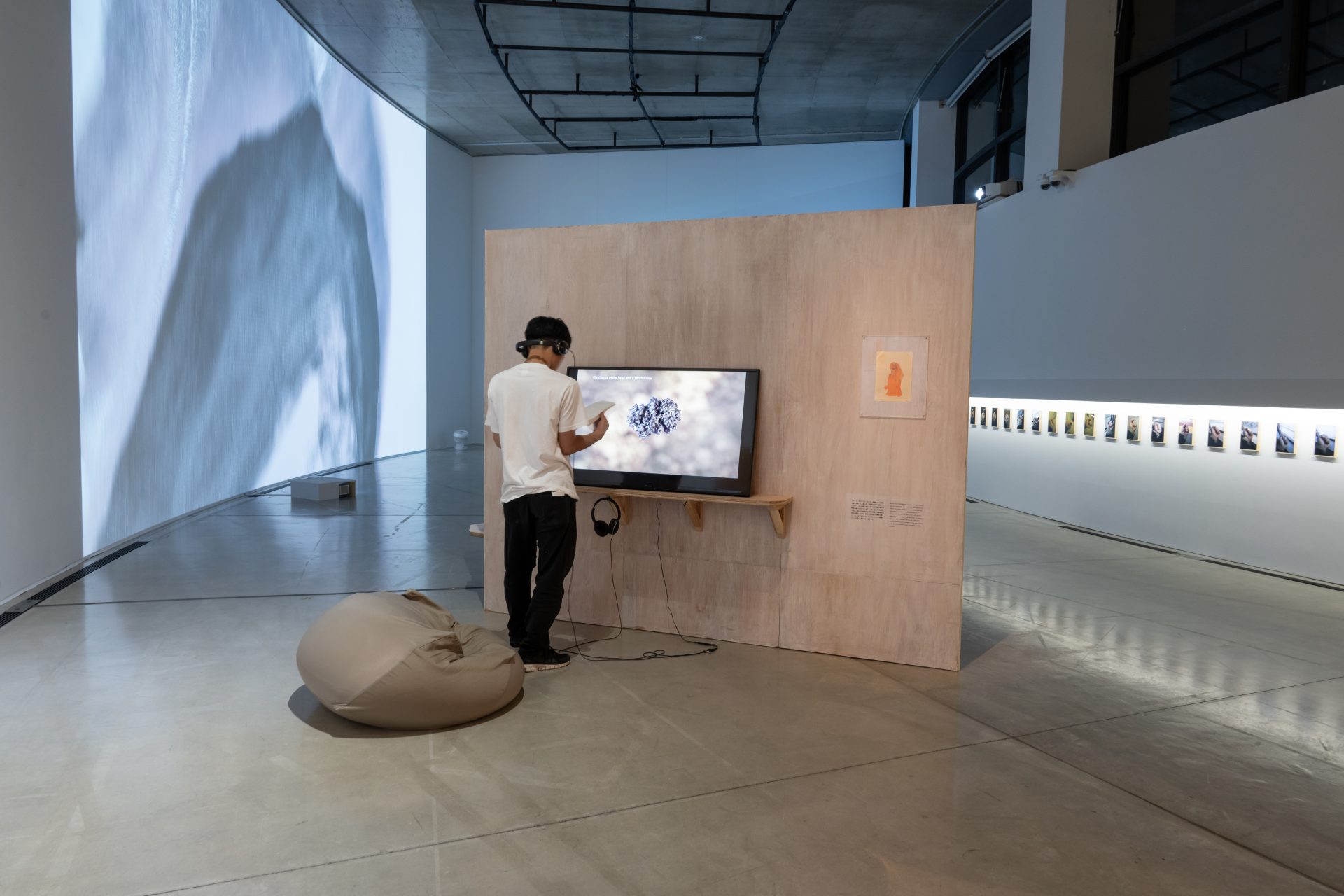
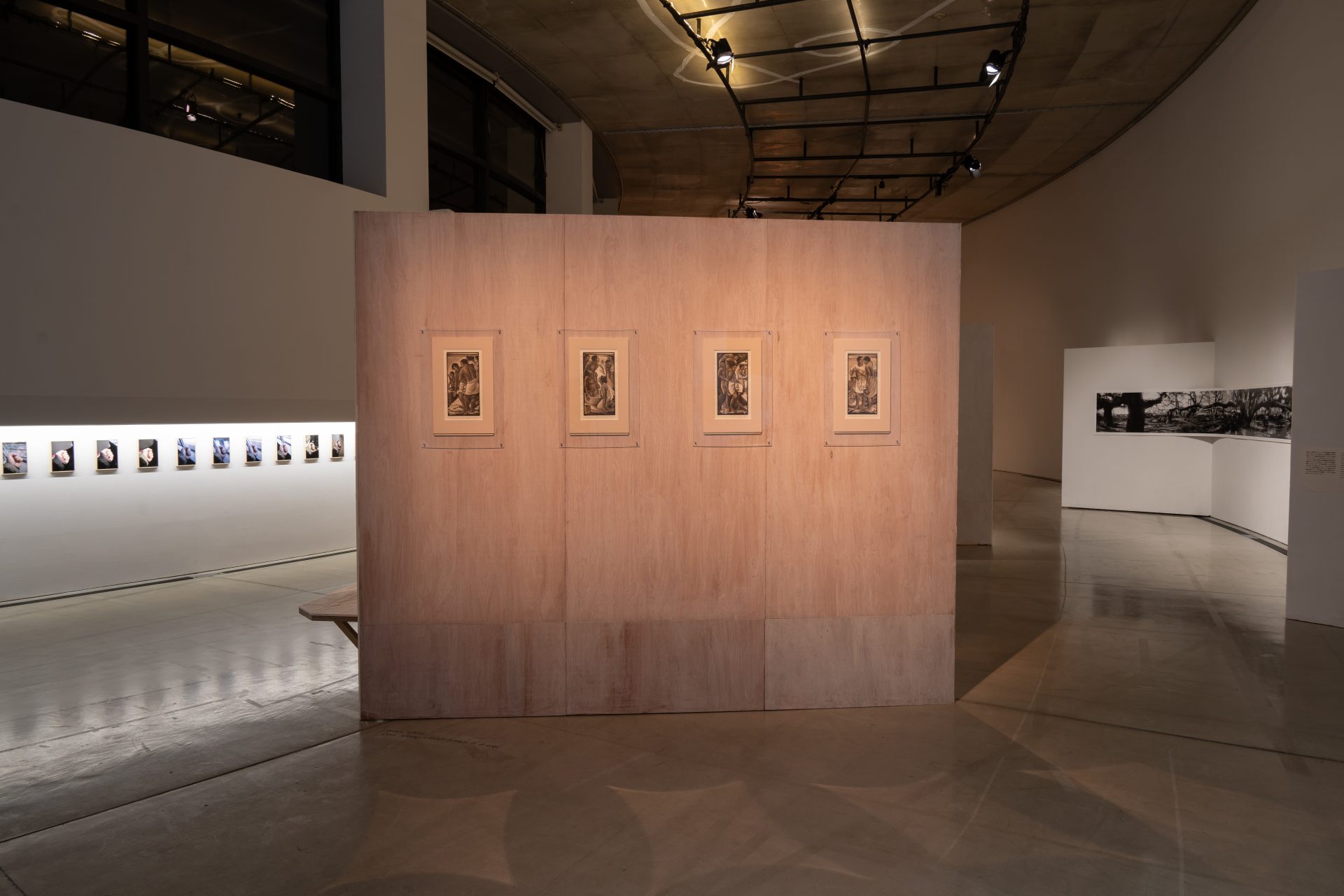
本展での彼はキュレーターの壁打ち相手のような存在だったと聞いた。確かに私が見た前期の展示では、多くの作家が参加している割にいわゆる会場構成的な大きな操作は行われておらず、背の低い三角平面の仮設壁(2,250mmH)で所々区切られつつも全体が緩やかに繋げられていた。仮設壁は展示室に対して背が低く、「カベ」というには頼りない。しかし三角平面の仮設壁が散りばめられることで、それが作品ではなく会場に属していることが直感的にわかる。「。(マル)」というほど明確ではないが、「、(テン)」のような存在感で空間の句読点となっていた。三角の壁は視線を受け止める、視線を受け流す、視線を二つにスプリットする、など複数の効果をもたらして展示にリズムを作る。改めて考えてみると真っ直ぐの壁ではカーブしている展示室の中で句読点として強すぎるのだ。
会場構成の仕事は、開幕ぎりぎりまでプランを練りたい作家に対して水を差して打ち合わせを設け、展示全体のクオリティを上げる仕事でもある。山川は当然そのような能力を持っていると推察するが、止まろうとしていない展示に無理に水を差さない柔軟さがあって、もう一人の作家のように振る舞っていると感じた。その姿勢が小さくて三角形の壁に表象されていたように思う。
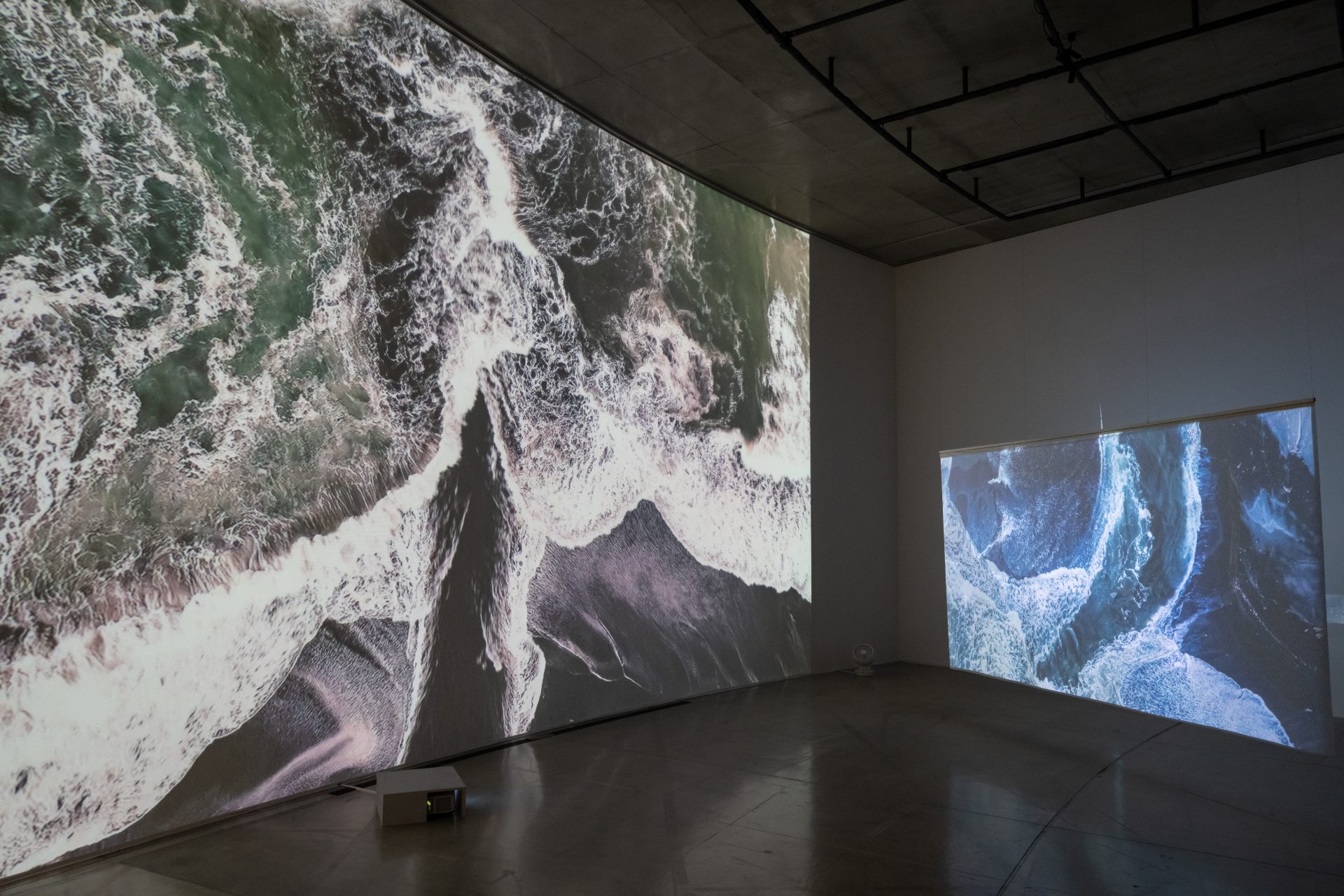
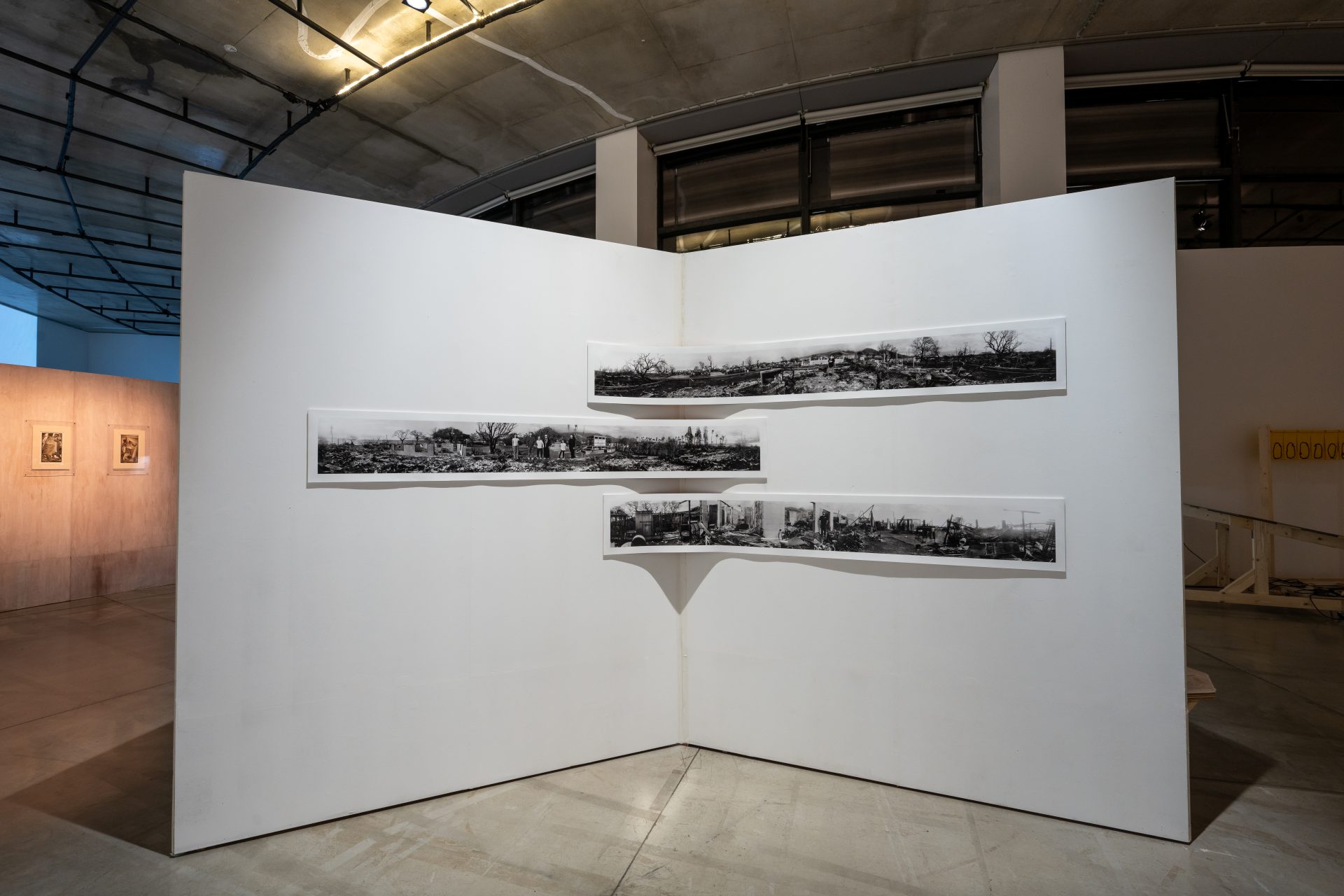
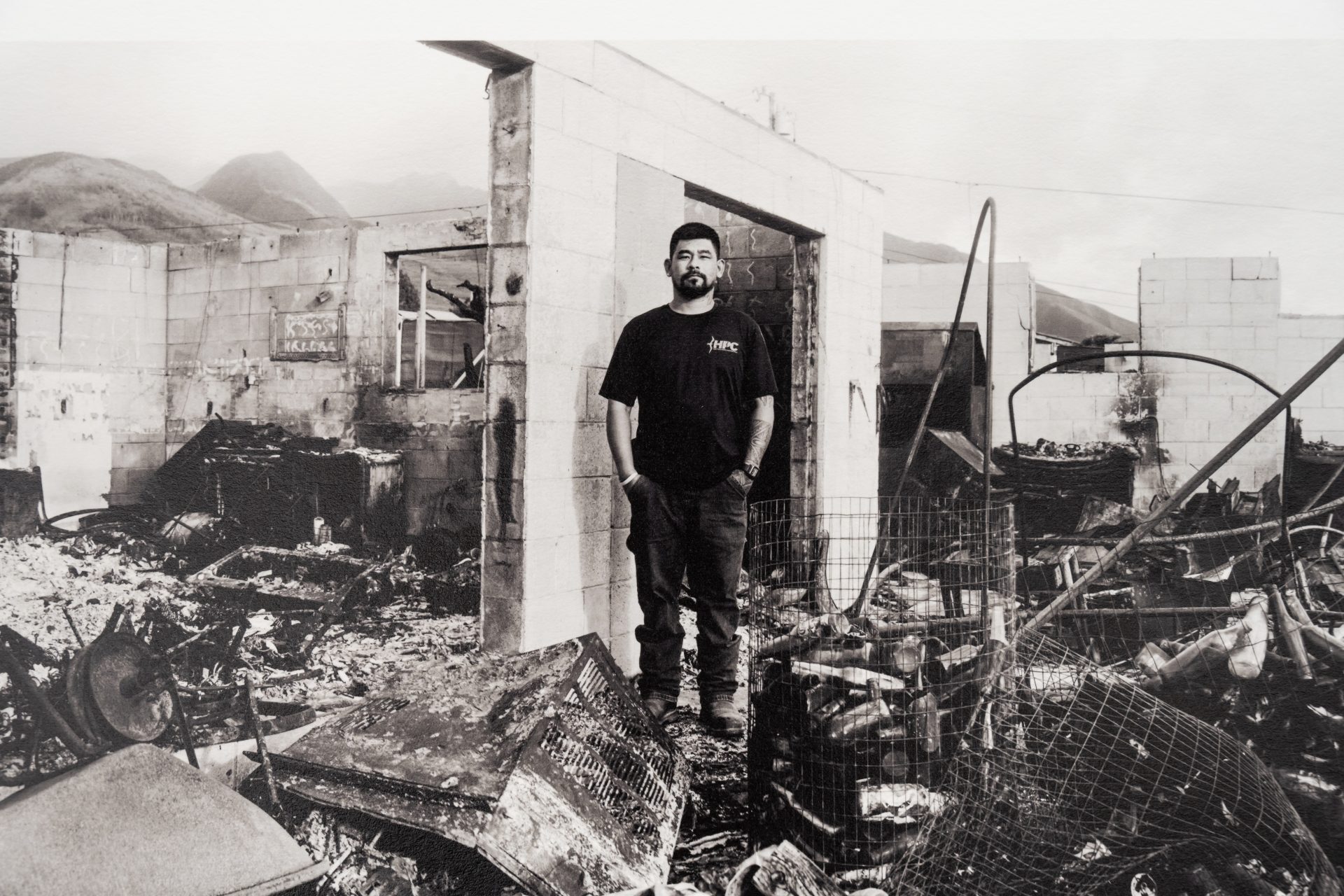
展示室入り口に投影された岩根愛の海の映像は、ドローンで撮られたとすぐにわかる鳥瞰の映像で、美しい映像とは裏腹に、私にはその無人航空機が使われている遠くの地の紛争が思い起された。岩根は奥に展示された《Island in My Mind, Lahaina》で冠婚葬祭のために転用された元軍用のカメラを作品のきっかけにしていることから、このドローンの利用も、そのような事情を踏まえた上でのことかもしれない。
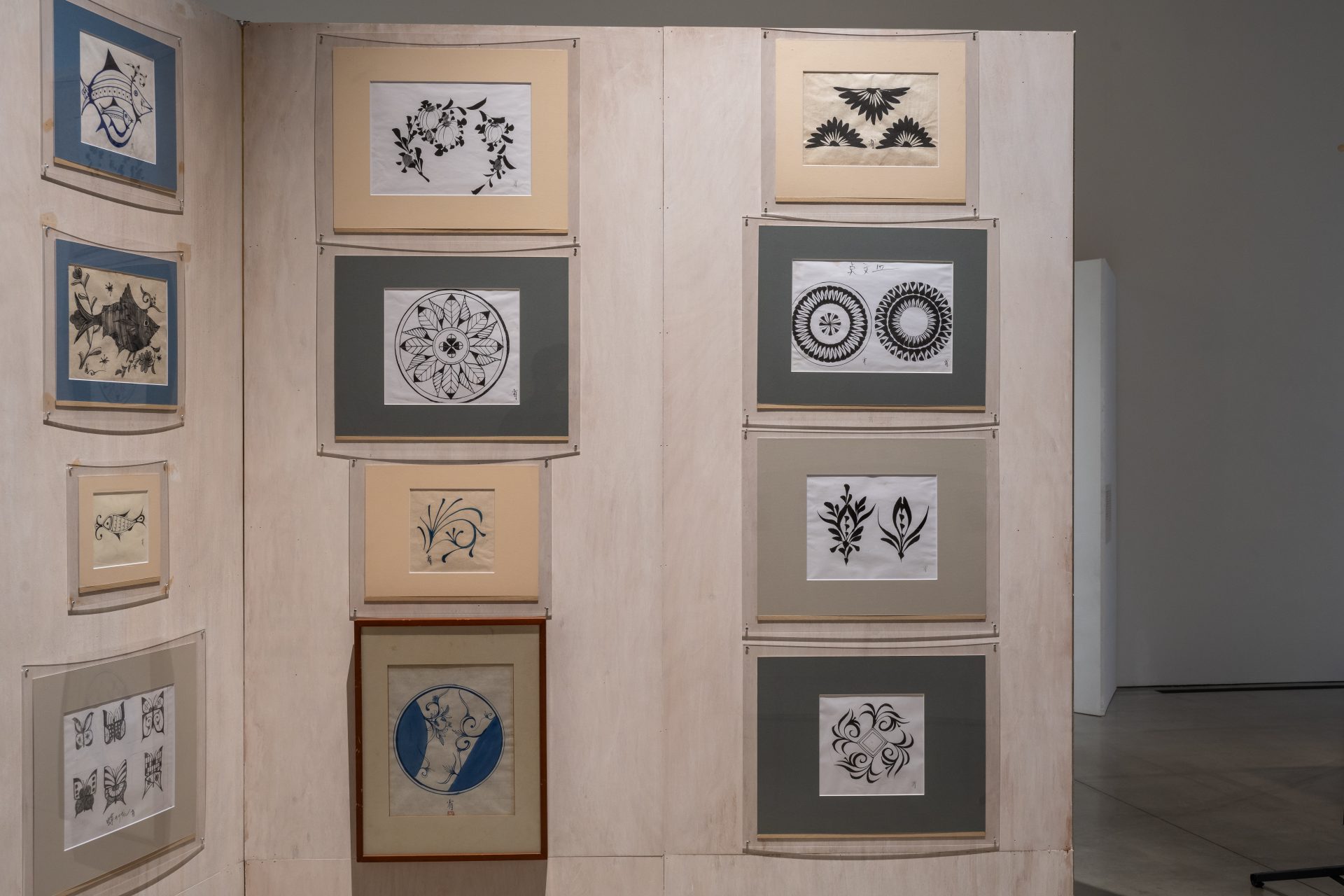
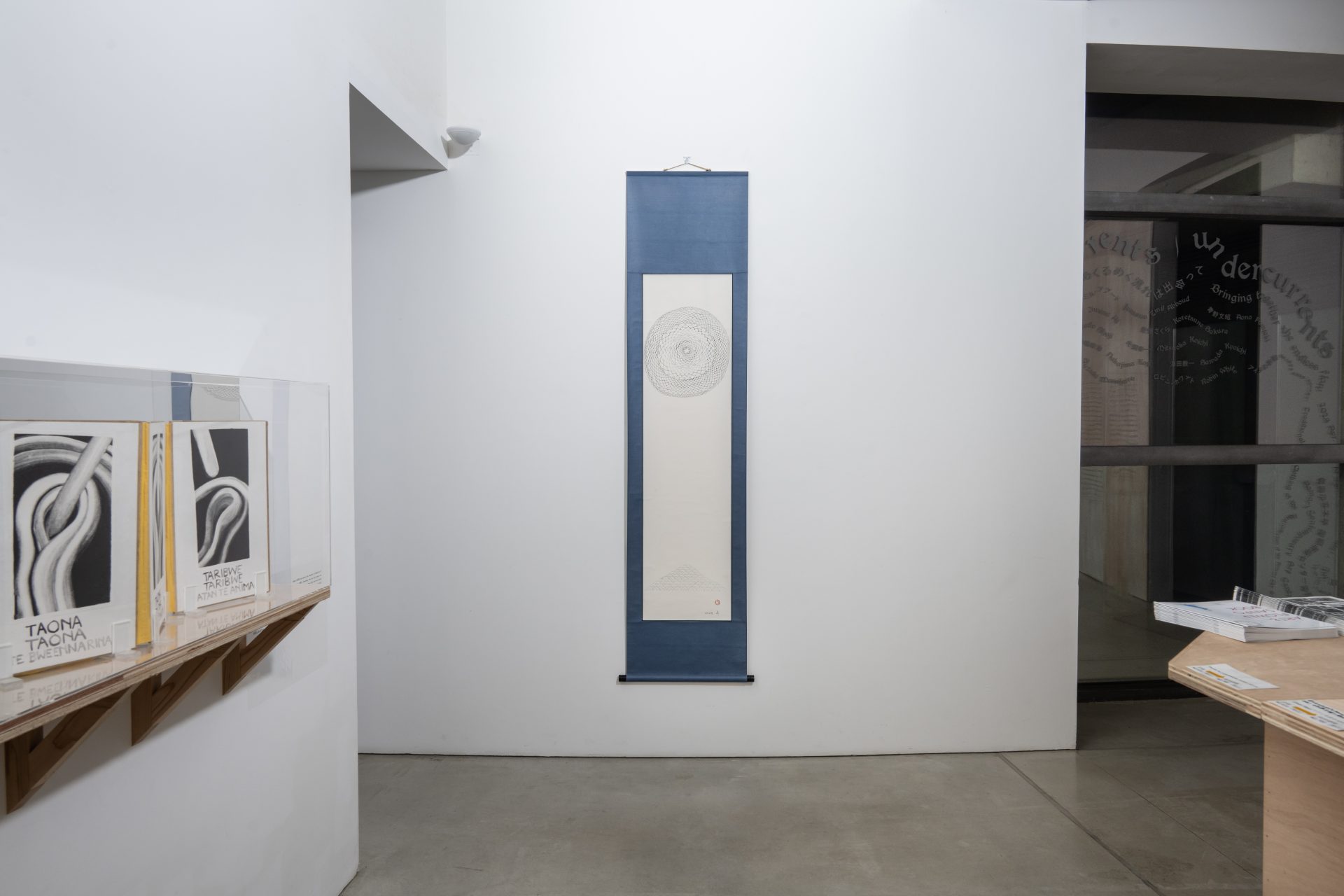
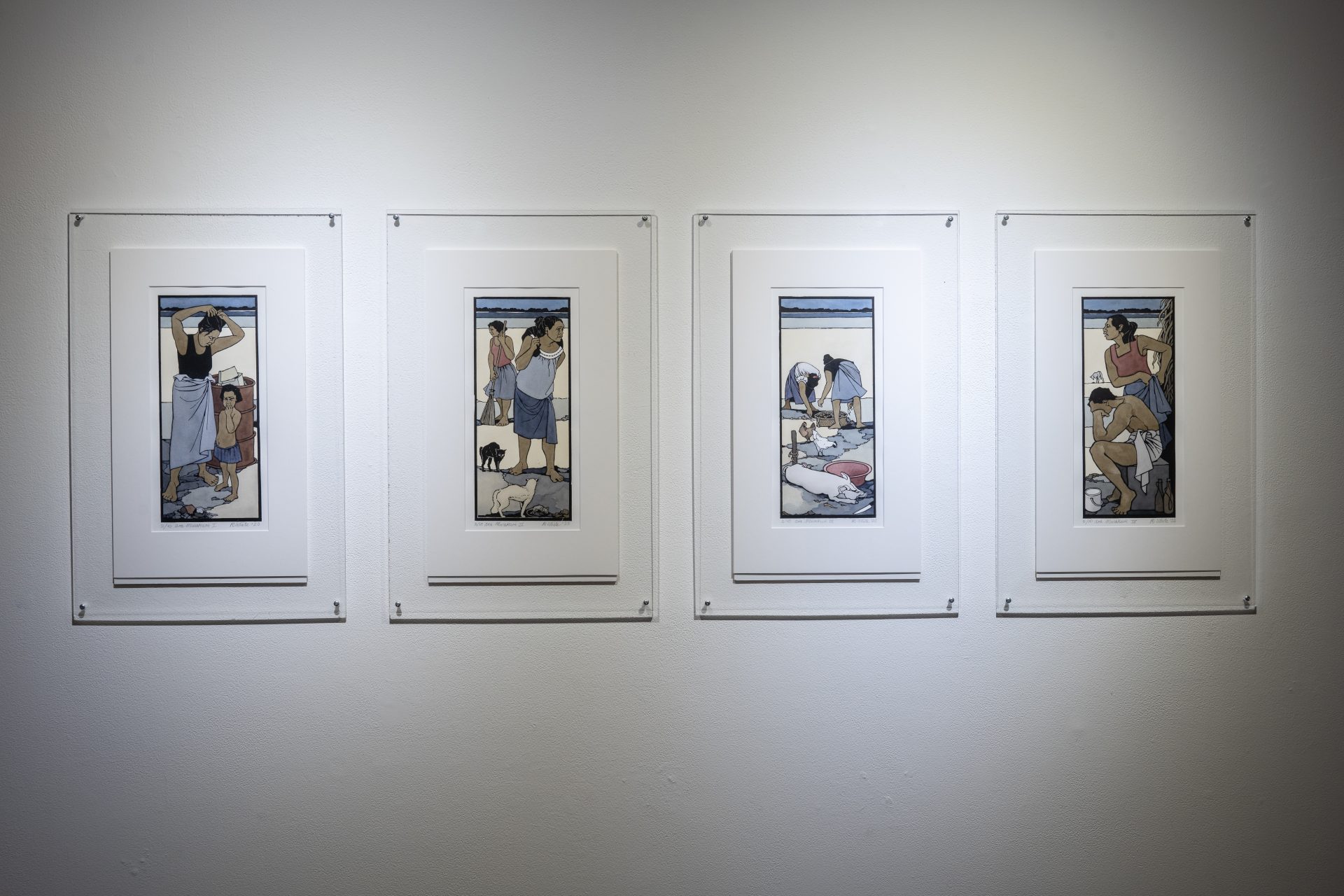
岩根の作品を通して葛藤の中に飛び込んだまま、パレスチナ出身のジュマナ・エミル・アブードの作品に出会うと、彼女の自由な制作のあり方に驚く。咄嗟の反応で彼女の作品に政治的な主張を探してしまったが、抑圧を受けている国々の作家に政治的な姿勢を押し付けてしまうことほど恐ろしいこともない。後期展の写真を見てもアブードは滞在先から発想を得て、新しいモチーフや素材に出会い、豊かな制作に励んでいたことが伺える。改めてアーティストという職業のするべきことに思いを馳せてみると、入り口の鈴木正治やロビン・ホワイト、またアブードの横に展示されている工藤省治といった絵を描く作家たちが、様々な言語や文化に触れる中で抽象を獲得し、作品同士が時代や地域を越えて互いにコミュニケートしているようにも感じられてきた。
アブードの絵を見て振り返ると、二つの三角壁の隙間に中嶋幸治の作品が見えている。作品の照明隠しのために付けられた屋根が二つの三角壁と合わさって、小さな作品群に自然と視線が導かれる。
カーブする小さな三角屋根の下に、青森から札幌に向かうまで花を握り締めた手を撮って並べている中嶋の《パルス》。介護・介助の家事労働に追われる中で、彼の制作には「できる時にできることをしておく」計画性が必要だったのではないだろうか。他の作家より先にインストールをした結果、クオリティの高い展示が導入部に置かれることで、全体の少し浮き足立った空気に楔を打っていた。
中嶋の作品は展示全体の試みと共鳴しているように感じ、心に残った。中嶋の別の展示作品《通過せよ》、《パチン》は、いずれも天候や他の人の都合によって形を得る作品だ。思い通りに動けない状況があるからこそ、移ろうものへの感動が深く表現されている。後期展で横一列からグリッド配置に並び替えられた《パルス》は、花を握りしめた手がジャンケンのグー、あるいはガッツポーズの集合にも見え出し、ある瞬間をホールドしようとする作家の力強い意思を受け取った。
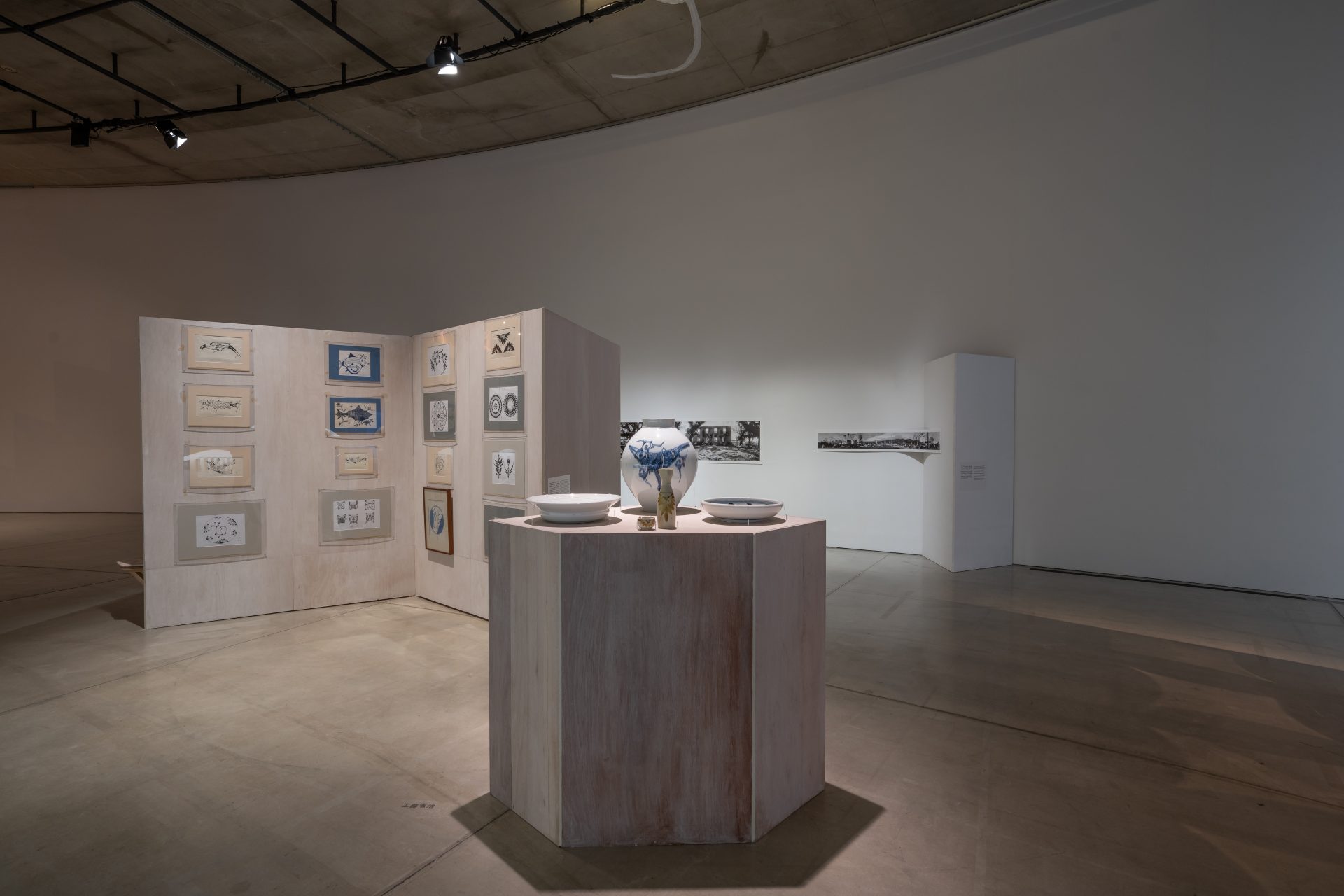
中嶋の作品列を抜けると、小さな作品群のために三角壁が点在したエリアに入り、最後に青野文昭の大作が充分なスペースを持って設置されている。会場構成者による、お手本のようなアーティキュレーションで、見事に難しい展示室が使いこなされていた。
自分の展示スペースで絵を動かす度、「いま」というものが立ち現れるように感じる。考えてみれば不思議だが、「いま」を感じるということと、「動くこと」は矛盾するどころか、切り離せない背中合わせのことだといつも思う。自分が止まっている時に何かが動いていることを感じること。あるいは自分が動いているときに何かが止まっていることを感じること。その感覚を「いま」と呼ぶのではないだろうか。つまり「いま」とは流れのことでも瞬間のことでもなく、流れと瞬間との関係のことなのだ。中嶋の作品はそのことを鋭く示唆していたと思う。そのように考えてみると、自分の仕事に対して感じていた矛盾にも合点が行く。大袈裟に言ってしまえば自分にとって展示を作るということは何かを止め、同時に何かを動かすことで、「いま」を表そうとすることなのかもしれない。葉が落ちる冬はバードウォッチャーにとって最高の季節だ。ACACの豊かな森を歩きながら、「いま」について思いを巡らせた。
写真:百頭たけし
-
佐藤 熊弥SATO Kumayamore
建築家・キュレーター。1991年東京生まれ。東京藝術大学油画専攻修士課程修了。西澤徹夫建築事務所を経て独立、現在は設計事務所tandem共同主催。主な仕事に「ある家族の会話」(集合住宅改修計画/2024年)「フランク・ロイド・ライト 世界を結ぶ建築/パナソニック汐留美術館」(展示デザイン/2024年)など。設計業務の傍ら展示の企画や絵のお店TANNERAUMの運営を行っている。
At every step, every gust of wind, I’d like to be able to say, “Now…” and “now” and “now.”
In the film Wings of Disire, the angels envy human beings for their existence within time. The word “now” may appear to denote a fixed moment, but it seems to be something we only perceive because of motion and flow. When I create exhibitions, I sometimes find myself unsure whether my work is about halting things―like paintings, or people’s footsteps―or setting them in motion. “currents / undercurrents ― Bringing together the endless flow” is a complex exhibition, reflecting the layered nature of Aomori, a place where many things accumulate over time. That complexity resonated with my own questions about the nature of exhibiting, and I found myself naturally drawn into the viewing experience.
The exhibition is divided into two parts―an earlier and a later phase―and this review is based solely on my visit to the former. Moreover, because of the nature of my work, I tend to focus more on the relationships between works than on the individual pieces themselves, which sometimes makes me feel unqualified to write an exhibition review. But in this case, those very tendencies seemed not only acceptable but even relevant, and I accepted the invitation to write without hesitation. Rather than seeing this as a typical group show, I perceived it as a unique form of expression―one that cannot travel to other venues―that reflects how ACAC, an Artist in Residence (AIR) program, is presently grappling with certain questions.
Following the artists’ residency period, the exhibition was reconfigured three months after the opening of the first phase, and I imagine the second phase presented a more settled atmosphere. Yet, the somewhat provisional and unpolished state of the first phase―which I saw―seemed to embody not only the spirit of this particular exhibition, but also the broader ambitions of the AIR program itself.
The ACAC exhibition space is a long, gently curving room about 20 to 30 meters in radius, with a width of 8.8 meters. Upon entering, the far wall is not immediately visible, creating a spatial experience that draws one inward, offering a subtle but unified sense of wholeness. Though it retains the clean proportions of a white cube, the space also allows for a sense of movement and flow―qualities unique to the AIR context. The ceiling is high, and the lack of columns makes it an unusually large single-volume room. One can imagine how artists might be tempted to create large-scale works here. And yet, witnessing how this exhibition expressed fine, nuanced movements through curatorial and spatial choices, I found myself thinking: perhaps this room had been waiting for just this kind of show.
YAMAKAWA Rick, who was responsible for the exhibition layout, is both an artist―known for works such as tour performances―and a trained architect with experience in spatial design. In a way, he occupies a position opposite to mine: while I transitioned from painting to architecture, he moved from architectural training into artistic practice. I’ve long been intrigued by his ability to combine solid design skills with the fluid, intuitive thinking of an artist.
For this exhibition, I heard that he acted as a kind of “sounding board” for the curator. Indeed, despite the large number of participating artists, the first phase I visited showed very little in the way of conventional, dominating spatial interventions. Instead, the space was gently segmented with temporary triangular walls―low in height (2,250mm)―which softly connected rather than firmly divided the space. These walls, being relatively low in the context of the exhibition room, felt too modest to be called “walls” in any assertive sense. And yet, because of their form and placement, it was immediately clear that they belonged to the space itself, rather than functioning as artworks. Not quite full stops―more like commas―they served as subtle punctuation marks within the gallery. Each triangular wall responded to the viewer’s gaze: catching it, diverting it, or splitting it. These interventions introduced a visual rhythm that shaped the exhibition’s pace. In retrospect, a straight wall might have asserted itself too strongly in a space defined by such a gentle curve.
The role of a spatial designer often involves interrupting artists―who may prefer to refine their plans right up until the opening―in order to coordinate and enhance the overall quality of the exhibition. I have no doubt that Yamakawa possesses this ability. But in this show, he seemed to exercise a different kind of strength: a flexibility that refrained from interrupting the exhibition’s natural flow, as if he were participating not as a coordinator, but as another artist. That attitude, I felt, was quietly embodied in the small triangular walls themselves.
At the entrance to the gallery, IWANE Ai’s projection of the sea was immediately recognized as aerial footage captured by a drone. Though visually striking, it also evoked for me the troubling reality of drones deployed in distant conflict zones. Considering that her work Island in My Mind, Lahaina, displayed further into the space, was inspired by a former military camera repurposed for ceremonial use, I couldn’t help but wonder if her use of the drone likewise carried such layered significance.
From that moment of unease, I encountered the work of Jumana Emil ABBOUD, an artist from Palestine, and was struck by the openness and freedom of her practice. My initial reaction had been to search her work for political statements―almost reflexively―but I was reminded how problematic it is to expect or impose political postures on artists from oppressed regions. Looking at images from the second phase of the exhibition, it’s clear that Abboud continued to draw inspiration from her stay in Japan, discovering new materials and motifs, and fully engaging in a richly generative artistic process. Taking a moment to reflect once more on the role of the professional artist, I came to realize that the painters – SUZUKI Masaharu and Robin WHITE near the entrance, and the late KUDO Shoji, whose pieces were on display next to Abboud’s work – had all acquired an ability to depict abstractions by engaging with various languages and cultures, and I felt as though their works were communicating with each other across time and place.
After viewing Abboud’s paintings, I turned around and caught sight of NAKAJIMA Koji’s work framed between two of the triangular walls. A small roof, installed to conceal the lighting, intersected with those walls, gently guiding the viewer’s gaze toward a cluster of modestly scaled works.
Beneath this softly curving triangular canopy, Nakajima’s Pulse presented a sequence of photographs showing a hand clutching a flower―taken during his journey from Aomori to Sapporo. Engaged in the daily demands of caregiving and housework, Nakajima likely required a certain pragmatism in his practice―doing what could be done when time allowed. Because he installed his work earlier than others, Pulse stood at the entrance as a finely composed piece, anchoring the slightly unsettled rhythm of the overall exhibition.
His work resonated strongly with the broader experiment of the show and left a lasting impression on me. His other pieces in the exhibition, Pass Through and Snap, were shaped by weather conditions or other people’s schedules. Precisely because of these constraints, his sensitivity to the fleeting and impermanent found profound expression. In the second phase of the exhibition, Pulse was rearranged from a horizontal row into a grid. In that format, the hands clutching flowers began to resemble a cluster of fists―like the closed hand in a game of rock-paper-scissors, or perhaps a series of quiet victory gestures. I sensed in that gesture a forceful will to hold on to a single, passing moment.
Passing through Nakajima’s series of works, I entered an area where triangular walls were scattered to accommodate smaller pieces. At the end of this spatial rhythm, AONO Fumiaki’s large-scale work had been given ample room to breathe. The articulation of space―precise and generous―demonstrated how expertly the challenging layout of the gallery had been navigated by the exhibition designer.
Each time I shift a painting in my own exhibition space, I feel something like a sense of “now” beginning to take shape. It’s curious, but I’ve always thought that sensing the “now” is not at odds with movement; rather, it emerges from the tension between motion and stillness. Perhaps it’s when something moves while I remain still―or when I move and notice what remains unmoved―that this awareness of “now” arises. In that sense, “now” is not merely a flow, nor a moment; it’s the relationship between the two. Nakajima’s work captured this idea with remarkable clarity. And when I think of it that way, the contradiction I’ve felt in my own practice starts to make sense. Perhaps, in a broader sense, creating an exhibition means to stop something, and simultaneously to set something else in motion―in order to give form to that elusive “now.” Winter, when the leaves fall, is the best season for birdwatchers. As I walked through ACAC’s rich forest, I found myself reflecting on what it means to sense the present.
Photo by HYAKUTOU Takeshi
-
SATO Kumayamore
Architect, curator. Born in Tokyo in 1991. Sato graduated from the Master’s Program of the Oil-Painting Department of Tokyo University of the Arts. After working for Tezzo Nishizawa Architects, he became an independent architect, and is currently the co-operator of tandem, a design firm. His major projects include Family Lexicon (Renovation plan for an apartment building/2024) and The Imperial Hotel at 100: Frank Lloyd Wright and the World (Exhibition design/Panasonic Shiodome Museum/2024). In addition to his design work, he plans exhibitions and runs the painting shop TANNERAUM.